The Book That Should Not Exist: A History of the Necronomicon, from Ancient Myth to Living Artifact
There are objects that accumulate meaning faster than their creators intended. Objects that begin as one thing — a prop, a story, a private joke — and end up as something the culture refuses to let go of, something that generates real consequences in the world regardless of its fictional origins. The Necronomicon is the most spectacular example in the history of horror literature.
H.P. Lovecraft invented it. But in the decades since, it has escaped.
Before Lovecraft: The Archaeology of a Dark Idea
To understand why the Necronomicon took hold the way it did, it helps to understand the landscape into which Lovecraft introduced it. The concept of a forbidden book — a text so dangerous that its mere existence constitutes a threat — has roots that run deep in both Western and Islamic intellectual tradition.
The grimoire tradition, stretching from medieval Europe through the Renaissance, produced texts like the Key of Solomon and the Grand Grimoire that were understood, by their readers and their censors alike, to contain genuinely operational occult knowledge. These were not novels. They were instruction manuals for practices that their authors believed would produce real effects in the real world. The danger they represented was concrete and taken seriously — the Catholic Church's Index of Forbidden Books was not a literary institution but a public health measure.
In the Islamic world, parallel traditions produced texts of similar nature and similar ambiguity. The Picatrix, a compendium of astrological magic translated from Arabic in the thirteenth century, circulated for centuries as a practical manual for influencing reality through ritual means. Its authors claimed ancient sources, lost originals, chains of transmission stretching back to figures who predated recorded history.
This was the convention Lovecraft was drawing on when he invented the Necronomicon: the ancient, authoritative, inherently dangerous text whose power derives from its relationship with knowledge that humanity was never meant to possess.
The Original Fiction
The Necronomicon first appears in Lovecraft's 1922 story The Hound, where it is mentioned almost in passing — a book a character consults, nothing more. But the idea lodged in Lovecraft's imagination, and in subsequent stories he elaborated it with the obsessive specificity that characterizes all his best work.
By the time of The Dunwich Horror (1929) and The Shadow Out of Time (1936), the Necronomicon had acquired a complete fictional history: it was written in the eighth century by the "Mad Arab" Abdul Alhazred, a poet from Sanaa whose relationship with the Great Old Ones had cost him his sanity and eventually his life. The original Arabic text — Kitab al-Azif, meaning something like "the sound of insects" or, in certain interpretations, "the sound made by demons at night" — was translated into Greek in the tenth century, then into Latin in the thirteenth. Various copies were suppressed, burned, lost. A few survived in academic libraries — Miskatonic University's collection chief among them.
The detail is significant. Lovecraft did not simply name his book. He gave it a provenance, a transmission history, a bibliography. He made it feel like the kind of thing a scholar might actually encounter in a catalog, might actually have a reasonable expectation of finding in an archive. This was his most dangerous innovation: he gave the Necronomicon the texture of a real historical object.
When Fiction Became Myth
The consequences of this decision began almost immediately. Lovecraft's correspondents — many of them writers themselves, operating in the same literary circles — began referencing the Necronomicon in their own fiction, building it into a shared mythology. August Derleth, Clark Ashton Smith, Robert Bloch: the book appeared in their stories with the same matter-of-fact authority as Lovecraft had given it, and each appearance increased its apparent reality.
By the mid-twentieth century, readers who were encountering the Lovecraft canon for the first time — without context, without access to the correspondence that made the invention clear — were beginning to inquire whether the Necronomicon might be real. Librarians at universities that Lovecraft had mentioned in his fiction received queries. Occult bookshops were asked for copies. A book that did not exist was generating a demand that could only be satisfied by making it exist.
In 1977, it was made to exist. A text published under the title Necronomicon, attributed to the "Mad Arab" and edited by a figure using the pseudonym "Simon," became one of the bestselling occult publications of the twentieth century. The Simon Necronomicon, as it became known, drew primarily on Sumerian and Babylonian mythology rather than anything in Lovecraft's fiction, but its existence answered a demand that Lovecraft's imagination had created fifty years earlier.
Multiple other versions followed. The Necronomicon had become what it had always been pretending to be: a real book with a publishing history.
The Object Itself: Why the Necronomicon Lives in Three Dimensions
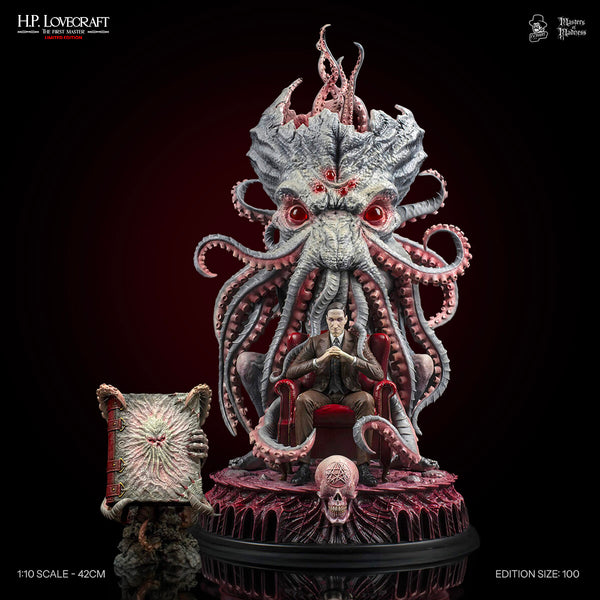
The Studio Everart Necronomicon replica was conceived around a single question: what would it look like if the book Lovecraft described had been made not by a human hand but by whatever the book is supposed to contain?
The answer we arrived at was that it would not look like a book at all. Not entirely. A text this old, this saturated with the energies of the entities it describes, would have ceased to be simply paper and binding. It would have incorporated the matter around it — or been incorporated by it. The boundary between the text and the thing the text describes would have dissolved.
Explore the Studio Everart Necronomicon replica
The result is a piece that functions simultaneously as a book and as something that has outgrown the category of book. The cover is covered in protrusions — veins, claws, tentacular elements — that read as organic rather than decorative. This is not ornamentation applied to a book-shaped object. This is the book transforming, the boundary between container and content collapsing. The suggestion, which is entirely intentional, is of a text that has become self-aware and is in the process of becoming something for which no existing word is adequate.
The sculpting required extensive reference work to achieve the right relationship between the book's legibility as an object and its horror as a presence. A Necronomicon that looked entirely like a book would be a prop. A Necronomicon that looked entirely like a monster would miss the conceptual point — the horror derives precisely from the threshold state, from the ambiguity of what category this object occupies. The veins that run across the cover are not purely decorative horror; they are the evidence of a process, an ongoing transformation that the collector witnesses in its current state without knowing where it terminates.
The hand-painting uses deep, layered pigment work — multiple washes of warm and cold tones that interact to suggest depth, a sense that the surface has layers, that something beneath the visible exterior is generating heat. The eyes, if they are eyes, are treated to suggest a light source that comes from within rather than reflecting any light the viewer might provide.
The Book That Refuses Containment
The Necronomicon is, at this point, genuinely real in every sense that matters for a cultural object. It exists in multiple physical forms. It has influenced literature, film, music, gaming, and visual art in ways that cannot be traced back to a single source because the source has become a distributed system. Lovecraft invented a book, and the book invented itself.
Studio Everart's version of this object is not a reproduction and not a prop. It is an argument: that the most faithful representation of the Necronomicon is the one that refuses to be merely a representation — that instead becomes, in miniature, the kind of thing the book has always been trying to become. Something that lives at the threshold between categories. Something you can hold and be slightly unsure whether you should.
That uncertainty is the point. It always has been.
The Necronomicon is available as a limited edition hand-painted polystone artifact. View the Piece

100 numbered pieces. Hand-painted. An original Studio Everart design.
€700,00 €760,00 View H.P. Lovecraft: The Forbidden Edition