The Man Who Dreamed the Monster: Inside the Studio Everart H.P. Lovecraft Statue
There is a question that haunts every serious reader of H.P. Lovecraft, the kind of question you find yourself asking at two in the morning after closing the last page of The Shadow Over Innsmouth or The Call of Cthulhu: did Howard Phillips Lovecraft invent these monsters, or did he merely find them?
The distinction matters. Because a man who invents monsters remains their master. He controls what they do, how far they reach, where they stop. But a man who finds them — who drags them up from some pre-rational stratum of his own unconscious — is never quite safe. The creatures he describes have already passed through him. They know the texture of his mind. They know where the walls are thin.
This is the premise behind Studio Everart's H.P. Lovecraft statue, and it is more philosophically precise than anything a straightforward portrait could achieve. We were not interested in representing Lovecraft as a gothic figurehead, a literary celebrity cast in polystone for the mantelpiece. We were interested in the truth his fiction keeps trying to tell us: that the man who creates horror cannot entirely escape what he has created.
The Composition: A Reckoning in Three Dimensions
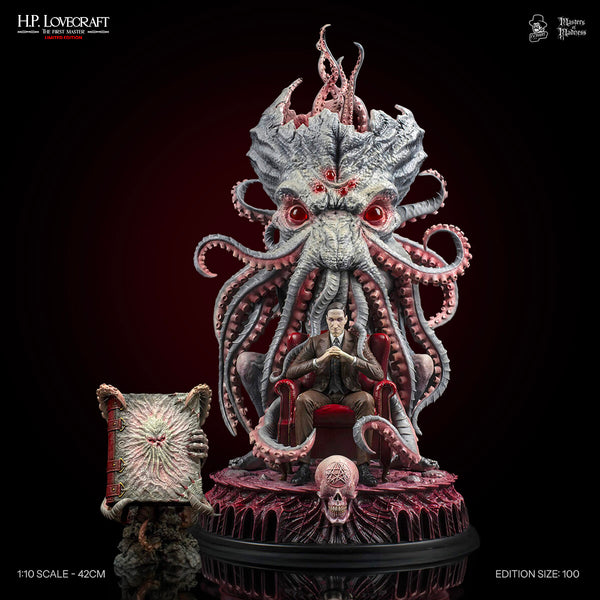
The statue presents Lovecraft in a moment of terrible stillness. He is seated, or implied to be — his posture is that of a man whose body has given up its urgency. The face is pensive, the gaze directed somewhere beyond the middle distance, somewhere that is not quite this room, not quite this world. Students of Lovecraft's life will recognize the expression. This is the face of a man who spent decades retreating from a reality he found actively painful into the private cosmologies of his imagination, only to discover that what he had built there was infinitely worse.
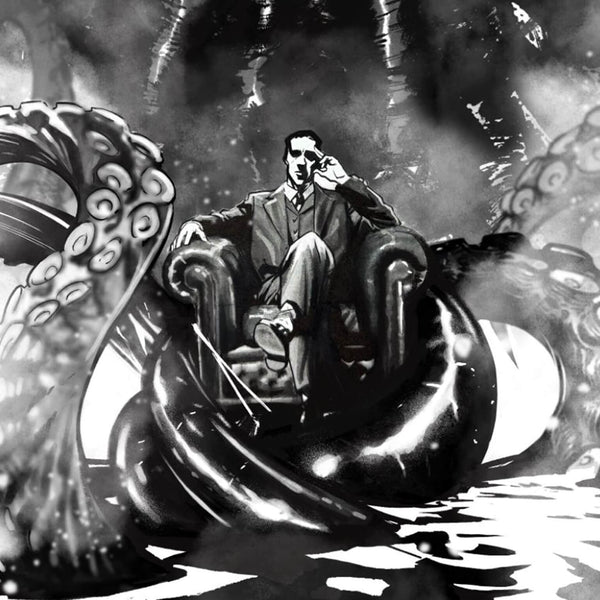
Behind him — and "behind" is the operative word, the spatial relationship that carries all the meaning — the transformation has begun.
The figure that rises from the darkness at Lovecraft's back is not yet complete. It is in the process of becoming. This was a deliberate sculptural choice, and it required months of iteration to achieve without losing the piece's emotional coherence. A fully realized monster would be spectacle. A monster in the act of forming is something else: it is dread operating in real time. The viewer's imagination, confronted with incompletion, does what Lovecraft always said imagination must do — it finishes the thought, and the thought it finishes is always worse than anything a sculptor could impose.
The creature's textures — the gathering of something organic and wrong, the suggestion of form finding its geometry — were executed using Studio Everart's multi-stage silicone molding process in premium polystone. The material allows for the kind of micro-detail that makes the difference between a surface that reads as monstrous and one that feels monstrous: pores that shouldn't exist, structures that belong to no taxonomy, the specific wrongness of flesh that has forgotten what it was for.
The Author Who Did Not Turn Around
What makes the statue narratively devastating is what Lovecraft does not do: he does not turn around.
He is aware, on some level. The stillness of his posture is not the stillness of ignorance — it is the stillness of a man who has decided, or perhaps has always known, that turning around would be the final mistake. In Lovecraftian fiction, the moment of confrontation with the absolute is almost always the last moment. Characters who look directly at what they should not see do not recover. They are institutionalized, destroyed, converted. The wisdom, such as it is, lies in the peripheral awareness — in knowing without knowing, in existing alongside the horror without demanding that it resolve.
Lovecraft spent his life doing exactly this. His fiction is populated with protagonists who are academics, investigators, rational men — men whose entire identity depends on the explicability of the world — and who discover that the world is not explicable. The machinery of reason does not survive contact with the Mythos. What survives, when anything does, is the capacity to live beside the knowledge that everything you believed about reality was wrong.
The Lovecraft figure in our statue has reached this accommodation. He is not fleeing. He is not fighting. He is present in the way that a man can be present after his fundamental assumptions about existence have been dissolved. The monster behind him is not an attack — it is a revelation. And he has decided to sit with it.
The Base: Where Horror Begins
Every element of a Studio Everart piece is load-bearing, and the base of this statue carries the weight of an entire mythological system.
The surface beneath Lovecraft's feet — and the creature's forming mass — is marked with the iconography of the Cult: the geometries and symbols that appear throughout the Mythos as the fingerprints of the Great Old Ones, the evidence of their ancient presence in the architecture of human civilization. At the center of this symbolic field is the Necronomicon itself, or its echo — the grimoire whose very existence Lovecraft seeded into fiction and whose cultural reality now exceeds anything he could have anticipated.
The Necronomicon on the base is not decorative. It is structural. It is the hinge on which the piece turns, the element that converts a portrait of a man and a monster into something cosmological. The book does not merely appear on the base — it opens the base, the way the fictional Necronomicon opens the barriers between what is and what should never be. What Lovecraft built in his stories, the base of this statue builds in three dimensions: a threshold.
The carving and detail work on the base required dedicated sculptural attention separate from the figure work above it. The symbols needed to read as genuinely ancient — worn at the edges, as if they had existed before the stone that contains them — while remaining legible enough to reward close inspection. The balance between legibility and entropy was one of the defining technical challenges of the piece.
An Edition Without Compromise
This statue is part of a strictly limited numbered edition of 100 pieces worldwide. The number is not arbitrary — it reflects what Studio Everart believes a genuine collectible should be: rare enough to mean something, plentiful enough to reach the collectors who will understand it.
Each piece is hand-painted by a single artist, using layered glazing, aggressive weathering with oil washes, and dry-brushing techniques developed specifically for this work. Because the hand-painting process introduces subtle variation, no two statues in the edition are identical. The piece you receive is yours in a way that goes beyond ownership.
The Lovecraft statue comes with a numbered base, a Certificate of Authenticity, and the particular weight — both literal and otherwise — of premium polystone. It is not a light object. It is not a comfortable one. It is designed for the collector who already knows that the most important things rarely are.
Why This Piece, Why Now
The horror collectible market is full of monsters. What it is short of is meaning.
Studio Everart's H.P. Lovecraft statue does not ask you to display a monster. It asks you to display an argument: that creativity and horror are not opposed but entangled, that the imagination which generates beauty and the imagination which generates dread operate from the same source, and that the most frightening thing a human being can encounter is the product of their own mind, given form, standing patiently at their back.
Lovecraft understood this. He spent his whole life not turning around. Our statue gives that understanding a permanent, three-dimensional home.
The H.P. Lovecraft Statue is available in a strictly limited edition of 100 numbered pieces. [View the Piece]
Discover the piece: H.P. Lovecraft: The Forbidden Edition, part of the Masters of Madness collection.

100 numbered pieces. Hand-painted. An original Studio Everart design.
€700,00 €760,00 View H.P. Lovecraft: The Forbidden Edition