H.P. Lovecraft was born in Providence, Rhode Island on August 20, 1890. He spent most of his life there, left once for New York in an ill-fated marriage, and returned as soon as he could. He died there in 1937, in his early forties, in a city he had never really left even when he was somewhere else.
Providence isn't incidental to the Mythos. It's structural. Understanding Lovecraft's relationship with the city explains choices in his fiction that otherwise seem arbitrary — the specific quality of the dread, the architecture that keeps appearing, the sense that horror isn't imported from elsewhere but native to the very streets he walked.
The City He Couldn't Leave
Providence in Lovecraft's time was a city in slow decline — a former colonial powerhouse that had lost its commercial importance, full of 18th-century architecture standing in various stages of decay. For most people this was an embarrassment. For Lovecraft it was everything.
He loved old things with a specific kind of love that was almost pathological: the past, to him, was more real than the present. The colonial-era buildings of College Hill, where he lived most of his life, weren't relics — they were the actual substance of reality, and the present was the intrusion. This isn't a metaphor. He wrote letters describing contemporary people and events with the detachment of someone observing an unwelcome interruption to something more important that had been happening for centuries.
That feeling — the present as thin membrane over something much older and stranger — is the emotional core of cosmic horror. Lovecraft didn't invent it abstractly. He extracted it from his daily experience of walking through a city that felt, to him, like it was haunted by its own history.
College Hill and Benefit Street
The neighborhood where Lovecraft spent most of his life, College Hill, sits above the Providence River and contains some of the oldest surviving colonial architecture in the United States. Benefit Street — which Lovecraft walked constantly — is lined with 18th and 19th century houses in various states of preservation.
This is the street behind "The Shunned House" (1924), one of his best stories: a house on Benefit Street where something wrong lives in the basement, something that has been there since before anyone currently living was born. Lovecraft used the real address — 135 Benefit Street — and the real history of the house, including documented illness among its former occupants. The horror in the story is inseparable from the specific texture of that specific street.
Visiting Providence today, the geography is still recognizable. The city has changed, but College Hill hasn't changed as much as most American neighborhoods of comparable age. The houses Lovecraft described are mostly still standing. Walking Benefit Street at dusk, it's not difficult to understand what he was drawing from.
The John Hay Library
Lovecraft spent enormous amounts of time at the John Hay Library at Brown University, a short walk from his home. The library holds one of the largest collections of Lovecraft manuscripts, letters, and original materials in existence — thousands of letters (he was a compulsive correspondent), draft manuscripts, and personal documents.
This is where the intellectual life that produced the Mythos actually happened: in the stacks of a university library in Providence, reading widely and writing constantly to a network of correspondents who would become, collectively, the weird fiction tradition. August Derleth, Clark Ashton Smith, Robert E. Howard — the entire circle formed largely through letters written from Providence.
Swan Point Cemetery
Lovecraft is buried at Swan Point Cemetery, in a plot that became a pilgrimage site long after his death. His original grave marker was modest; a second stone was added by fans in 1977, inscribed with the phrase he used in letters to describe his philosophy: "I am Providence."
He meant it literally. The city and the work were not separate things. Providence wasn't where Lovecraft happened to live — it was what he was made of, and what the Mythos is made of.
Bringing Providence Home
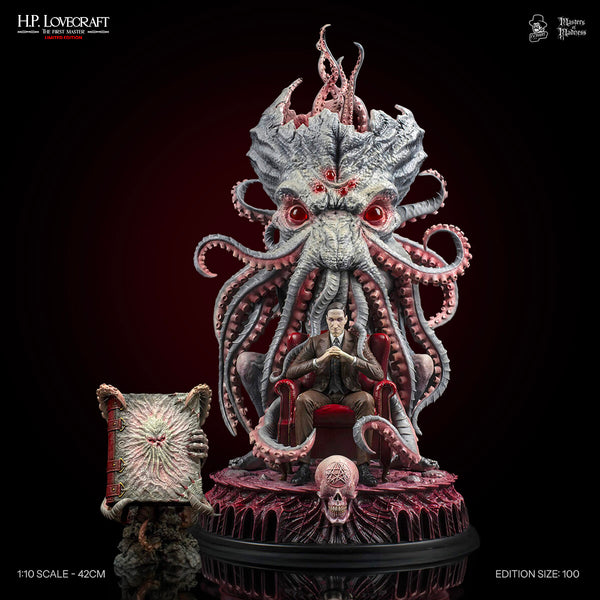
For collectors who understand Lovecraft as a biographical subject — the man behind the Mythos, not just the creature-designer — the H.P. Lovecraft Master statue is the piece that makes sense. Not Cthulhu. Not a tentacled horror. Lovecraft himself: the writer at his desk in Providence, the source of everything that followed.
Hand-painted polystone, 100 numbered copies, original IP. The figure captures Lovecraft as the literary figure he became — and as the man who never really left the city that made him.
The H.P. Lovecraft Master — Masters of Madness collection →
Frequently Asked Questions
Where did H.P. Lovecraft live in Providence?
Lovecraft lived at several addresses in Providence over his life, most of them on or near College Hill. The most significant is 66 College Street, where he lived from 1933 until his death in 1937 — considered his final and most settled home. Earlier, he lived at 454 Angell Street and 598 Angell Street, among others. All of these addresses are within a few blocks of each other in the College Hill neighborhood.
Can you visit Lovecraft's Providence today?
Yes. The Providence Preservation Society and several local tour operators run Lovecraft-themed walking tours of College Hill and Benefit Street. Swan Point Cemetery, where Lovecraft is buried, is open to visitors. The John Hay Library at Brown University holds the primary Lovecraft archive and offers periodic exhibitions. The neighborhood itself — particularly Benefit Street — is largely intact and immediately recognizable from Lovecraft's descriptions.
What is "I am Providence"?
"I am Providence" is a phrase Lovecraft used in personal correspondence to describe his relationship with the city. It appears in a letter written near the end of his life and expresses the totality of his identification with Providence — not just as a place of residence but as a constitutive part of his identity. The phrase was chosen for his memorial grave marker at Swan Point Cemetery, added by fans in 1977, and has since become the most quoted expression of the Lovecraft-Providence connection.

100 numbered pieces. Hand-painted. An original Studio Everart design.
£599.00 £651.00 View H.P. Lovecraft: The Forbidden Edition