The Cure That Cannot Be Found: On Norah Everhart, Studio Ever Art, and the Search for Timeless Art
There are coincidences that arrive with the weight of inevitability, that feel less like accidents and more like the universe making a point it considers overdue. When the team behind Studio Ever Art first encountered the protagonist of Call of the Sea — a 1940s adventure game set in the South Pacific, steeped in Lovecraftian dread, built around the relentless pursuit of something irretrievably lost — her name stopped them cold.
Norah Everhart.
Not Everart. Everhart. But close enough, in the way that mirrors are close: reversed, slightly distorted, carrying the essential shape of the thing they reflect.
Norah's Search and What It Means
For those unfamiliar with Call of the Sea: Norah Everhart is a woman in failing health who travels to a remote Pacific island in search of her missing husband, a researcher who disappeared while investigating something he clearly should not have investigated. The island is beautiful in the way that Lovecraftian settings are always beautiful — abundantly, disturbingly, in ways that suggest the beauty is accidental, a byproduct of processes indifferent to aesthetic value.
As Norah descends deeper into the island's mysteries, a second narrative emerges alongside the search for her husband. She is also, in the most literal biological sense, transforming. Her illness is not simply illness. It is a calling. The cure she seeks, it gradually becomes clear, is not a return to what she was — it is the completion of what she is becoming.
This is the Lovecraftian move at its most sophisticated: the thing you are searching for and the thing you are becoming are the same thing. The journey outward and the journey inward converge. The cure and the corruption are indistinguishable.
We thought about Norah Everhart for a long time after encountering her. We thought about what it means to search for something you cannot name, to pursue a destination you can only recognize upon arrival, to commit completely to a path whose logic only becomes apparent in retrospect.
We thought about our own name. Ever Art. Art that endures. Art that exceeds the moment of its making and continues to mean something when the context that produced it has dissolved.
And we realized that what Norah Everhart is searching for — the thing she cannot find because it requires her transformation to become visible — is what we are searching for every time we begin a new piece.
The Problem with Collectibles That Are Just Objects
The horror collectible market is enormous, diverse, and almost entirely oriented toward the recognizable. Licenses are acquired. Beloved characters are reproduced in resin or polystone or mixed media, packaged in dramatic boxes, photographed at flattering angles, sold to audiences who want a three-dimensional version of something they already love in two dimensions.
This is legitimate. There is nothing wrong with wanting a physical artifact of a beloved story. But it is, at its core, a transaction in familiarity. The object's value is borrowed — it derives from the affection that already exists for the source material. Remove the IP, and what remains is skilled manufacturing.
Studio Ever Art was built on a different premise, and the distinction matters more to us than it perhaps should.
We do not acquire licenses. We do not reproduce existing characters. Every piece we make begins as an idea, works its way through concept and narrative development, gets argued over and refined and sometimes abandoned and started again, and arrives as a sculpture that did not exist before and could not have existed without the specific sequence of choices that produced it.
This means our work is more exposed. A statue of a famous monster arrives with its meaning pre-loaded — the audience brings their existing relationship with the character, and the sculptor's job is to honor that relationship in three dimensions. A statue of an original concept must earn its meaning from scratch. It must generate affect through its own compositional logic, its own narrative coherence, its own handling of space and texture and weight.
This is harder. It is also the only kind of work we are interested in doing.
The Lovecraftian Collection and Why It Had to Be This
When we decided to build our first major collection around the Lovecraftian universe, the decision required careful thinking.
Lovecraft is not, technically, an IP in the conventional sense. His work is in the public domain, and his mythology has been so thoroughly absorbed into the cultural commons that it functions more as a shared imaginative space than as a discrete creative property. But this very openness creates its own obligations. Work that enters the Lovecraftian tradition without genuinely engaging with its philosophical content is immediately legible as opportunistic — as aesthetic without substance, as tentacle-shaped decoration rather than cosmic horror in any meaningful sense.
We did not want to make tentacle-shaped decoration.
Our approach to the Lovecraftian collection follows the same logic that drives all Studio Ever Art work: we are interested in the psychological and philosophical content of the source material, not merely its visual vocabulary. What Lovecraft was actually doing — beneath the purple prose, beneath the cosmic geography, beneath the elaborate pseudomythology — was constructing a phenomenology of terror. He was describing, with obsessive precision, what it feels like to encounter a reality that exceeds the mind's capacity to process it.
That is what our statues are about. Not monsters as decoration. Monsters as epistemic events. The moment of encounter not as spectacle but as transformation.
For Few, in Every Sense
Norah Everhart's cure was not available to everyone. Its discovery required a particular constitution, a particular history, a willingness to follow something unknown into territory that most people would have abandoned at the first sign of wrongness.
Studio Ever Art's work is similarly selective — not because we believe in exclusivity as a value in itself, but because the kind of attention these pieces require and reward is genuinely rare.
Our editions are limited to 100 numbered pieces. This is not a marketing decision. It is a practical consequence of how the pieces are made: each one is hand-painted by a single artist, using techniques that cannot be scaled without becoming something different from what they are. The limitation is built into the process.
But the more important limit is in the meaning. These are not objects for every shelf. They are objects for the collector who has spent years building a relationship with the literature, the mythology, the specific aesthetic of cosmic horror — who has something genuinely at stake in the question of how that tradition gets represented in three dimensions. For that collector, the work we are making represents a kind of cure: the satisfaction of an appetite that most of the market has never tried to feed.
Like Norah, they have been searching for something they could not name. Like Norah, the thing they were searching for required their transformation to become visible.
We are building the thing they have been searching for. We will know we have succeeded when they recognize it — not because it resembles something they already knew, but because it answers something they had stopped believing could be answered.
Discover the Lovecraftian Collection at Studio Ever Art. [Explore the Collection]
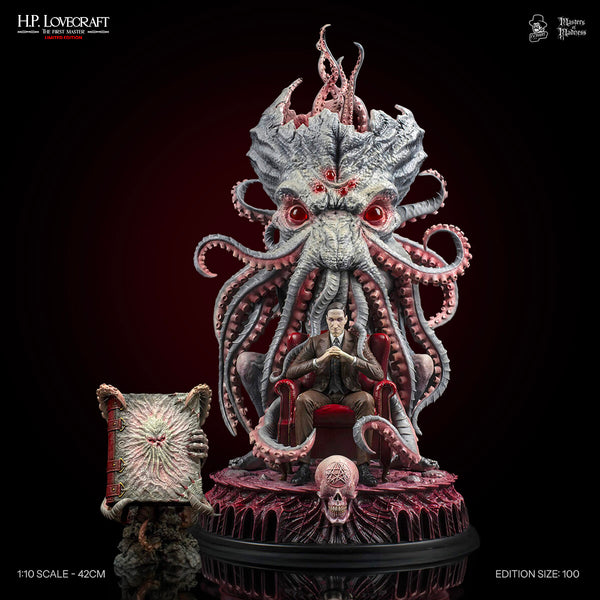
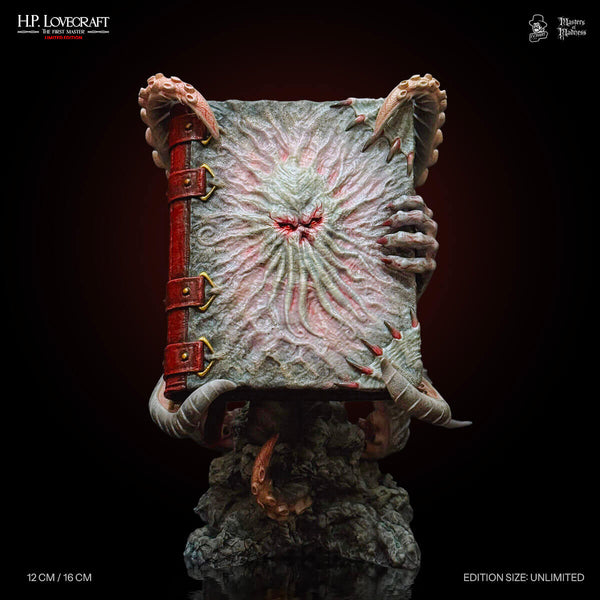
H.P. Lovecraft: The Forbidden Edition
100 copie numerate. Artigianato italiano. IP originale.