Why Lovecraft Belongs in Every Serious Dark Art Collection
There is a specific kind of collector who understands that a horror collection is not about fear. It is about aesthetic philosophy. It is about choosing to live surrounded by the artists and thinkers who mapped the edges of human consciousness — the writers, the painters, the sculptors who looked at the dark and decided to document it with precision and beauty.
Howard Phillips Lovecraft (1890–1937) is the defining figure of that territory. Not because his work is the most frightening. But because no other writer in the history of horror has constructed a mythology so internally consistent, so philosophically ambitious, and so visually fertile that it has become a collecting universe unto itself.
This guide is for the collector who wants to understand what they are actually acquiring when they invest in a Lovecraft piece — and why it matters.
The Mythology: What Makes Lovecraft Different
Most horror is personal. A monster threatens a person. A haunting affects a house. A killer targets victims. The threat is comprehensible, the scale is human.
Lovecraft invented something different: horror at a cosmological scale.
In his universe — the Cthulhu Mythos — humanity is not the protagonist of existence. We are a geological accident on an unremarkable planet, and the entities that preceded us are so vast, so alien, and so indifferent that encountering them does not produce fear. It produces a specific kind of existential collapse that Lovecraft called cosmic dread.
The Great Old Ones — Cthulhu, Nyarlathotep, Azathoth, Shub-Niggurath — are not evil. They simply do not notice us. The horror is not malice. It is irrelevance.
This idea has proven extraordinarily durable. In an era of space telescopes and quantum physics, when science keeps confirming how small and brief human existence truly is, Lovecraft's central insight feels more relevant than it did in 1926.
The Mythos for Collectors: A Universe to Navigate
What makes Lovecraft exceptional as a collecting subject is the density of his universe. Other horror writers created characters. Lovecraft created a cosmology — complete with geography (Arkham, Dunwich, Innsmouth, R'lyeh), sacred texts (the Necronomicon, De Vermis Mysteriis), and a hierarchy of entities that dozens of other writers have expanded over nearly a century.
Collecting Lovecraft is collecting an idea system. Every piece — whether a first edition of Weird Tales, a polystone statue, or an original illustration — is a node in that system. The serious collector understands this. They are not buying an object. They are acquiring a position within a mythology.
The Aesthetic: What a Lovecraft Piece Should Communicate
The most common mistake in Lovecraft-adjacent collectibles is the reduction of the Mythos to its surface symbols: tentacles, eyes, green slime. These are the trappings. They are not the substance.
The substance is the author himself. Lovecraft was a man of profound contradiction — erudite, paranoid, isolated, brilliant, deeply flawed — who channeled his anxieties into a mythology that has outlived him by nearly a century. The most powerful Lovecraft collectibles engage with the man, not just the monsters he created.
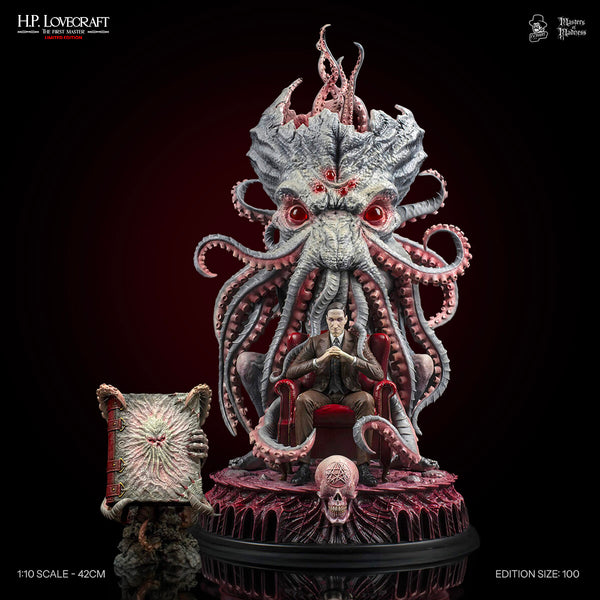
This is the design philosophy behind the Studio Everart approach: to honor Lovecraft as a literary figure, not reduce him to a creature vendor. The Masters of Madness Chapter I statue depicts the writer himself — not Cthulhu, not the Necronomicon — in the moment of creative obsession that defined his mythology.
The Market: What Serious Collectors Need to Know
The Lovecraft collectible market has matured significantly in the last decade. Key trends the serious collector should understand:
Artist authorship commands premium. Mass-produced resin figures have flooded the market. What retains and grows in value are pieces with documented artistic lineage — named sculptors, named painters, numbered editions with provenance. The collector who buys anonymously produced figures is buying decoration. The collector who buys documented editions is building an asset.
The author-as-subject is underrepresented. The vast majority of Lovecraft collectibles depict Cthulhu or other Mythos entities. Pieces that represent Lovecraft himself — the literary figure, the biographical subject — remain genuinely rare. This scarcity has both cultural and market implications.
Edition size matters more than price. A 500-piece edition at €200 is a less interesting asset than a 100-piece edition at €700. Scarcity is not a marketing tactic. It is the fundamental driver of long-term collectible value.
What the Serious Collector Should Look For
When evaluating a Lovecraft collectible, ask these questions:
- Who made it? Named sculptor, named painter. Not "made in" without attribution.
- How many exist? 100 is meaningfully different from 1,000. Verify the claimed edition size.
- What does it represent? A creature or the mythology? A product or a statement?
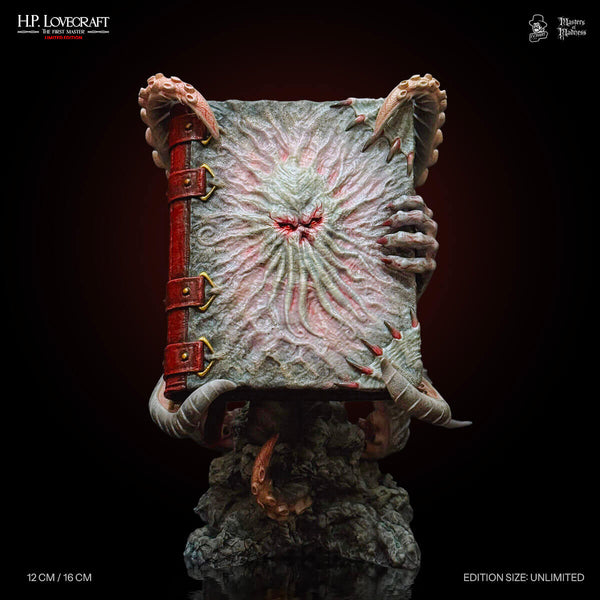
- What is included? A certificate, a box, accompanying pieces — these signal whether the producer treats the collector as a serious buyer or a transaction.
- Will it be reproduced? An edition that will never be reprinted is categorically different from a "limited" run that could restart.
The Masters of Madness collection by Studio Everart answers all of these questions with specificity: 100 pieces total, named sculptors (Giacinto Platania and Simona Bordonaro), numbered certificates, and a commitment to never reproduce the edition. That specificity is what separates a serious collectible from a decorative object.
The Long View: Why Lovecraft Endures
H.P. Lovecraft died in 1937, poor and unknown. Today, his mythology permeates gaming, cinema, literature, and visual art. The Cthulhu Mythos has been expanded by hundreds of writers. His fictional Necronomicon is referenced in mainstream culture. Bloodborne, one of the most critically acclaimed video games of the 21st century, is an extended meditation on Lovecraftian themes.
Collecting Lovecraft is collecting a mythology that has already proven its staying power across nearly a century. It is one of the few horror collecting subjects where the cultural foundation is demonstrably durable.
For the collector who thinks in decades rather than seasons, that durability is the most important data point of all.
H.P. Lovecraft: The Forbidden Edition
100 copie numerate. Artigianato italiano. IP originale.