What Is the Cthulhu Mythos — And Why Does It Matter to Collectors?
The term "Cthulhu Mythos" was not coined by Lovecraft. It was named posthumously by his friend and fellow writer August Derleth in the 1940s. But the system it describes — the interconnected cosmology of ancient entities, forbidden knowledge, and human insignificance — was entirely Lovecraft's creation, developed across two decades of pulp fiction and correspondence.
For the serious collector, the Mythos matters for one reason above all: it is a genuinely open universe. Unlike proprietary fictional systems, Lovecraft's mythology exists in the public domain. It has been expanded, reinterpreted, and contested by hundreds of writers, artists, game designers, and filmmakers. What you are collecting when you acquire a Mythos piece is your position within that ongoing cultural conversation.
The Architecture of the Mythos: A Collector's Map
Understanding the Mythos hierarchy is essential for the serious collector who wants to make meaningful acquisitions rather than random purchases.
The Outer Gods — the highest tier. Azathoth, the blind idiot god at the center of the universe. Nyarlathotep, the crawling chaos and sole entity with apparent interest in humanity (malevolent interest, but interest nonetheless). Yog-Sothoth, the gate and the key.
The Great Old Ones — the tier most familiar to popular culture. Cthulhu, sleeping in R'lyeh beneath the Pacific. Hastur the Unspeakable. Shub-Niggurath, the Black Goat of the Woods. These are powerful entities that existed on Earth before humanity and will return when the stars align correctly.
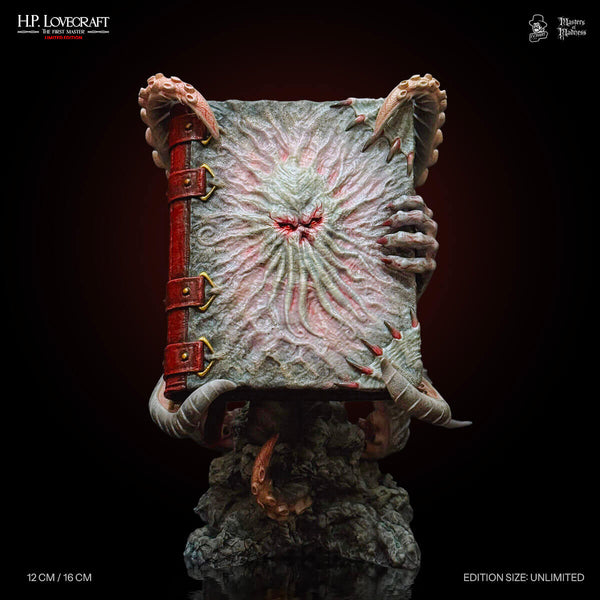
The Mythos Texts — the sacred books that appear throughout Lovecraft's fiction. The Necronomicon is the most famous, but De Vermis Mysteriis, the Book of Eibon, and others populate the Mythos library. These texts are themselves collecting subjects — from Lovecraft's original descriptions to the elaborate replica editions produced for serious collectors.
Cthulhu: The Entity vs. The Icon
Cthulhu has a problem that Lovecraft's other creations do not: it has become kitsch. Cthulhu plush toys, coffee mugs, and phone cases have created a cultural context in which the entity's original philosophical weight has been almost entirely obscured.
This creates an opportunity for the serious collector. While the mainstream market is saturated with Cthulhu merchandise, what remains genuinely rare is Cthulhu as Lovecraft intended it — as the visible face of an alien cosmology, represented with the gravitas and craft that the concept deserves.
The distinction is similar to the difference between a tourist souvenir reproduction of the Mona Lisa and an original work by an artist genuinely engaging with Da Vinci's techniques and intentions. The subject is the same. The relationship to the subject is entirely different.
The Lovecraft Himself: The Underrepresented Subject
Here is the collecting insight that most buyers miss: Lovecraft himself — the man, the writer, the biographical subject — is dramatically underrepresented in the collectible market.
Ninety percent of Lovecraft-adjacent collectibles depict Cthulhu or other Mythos entities. Almost none engage with the author who created all of it. This gap represents both a cultural blind spot and a market opportunity.
The most significant Lovecraft pieces in the next decade will not be the thousandth Cthulhu variant. They will be the pieces that treat Lovecraft the way we treat Poe, Kafka, or Borges — as a literary figure whose biography, psychology, and creative process are as compelling as the mythology he produced.
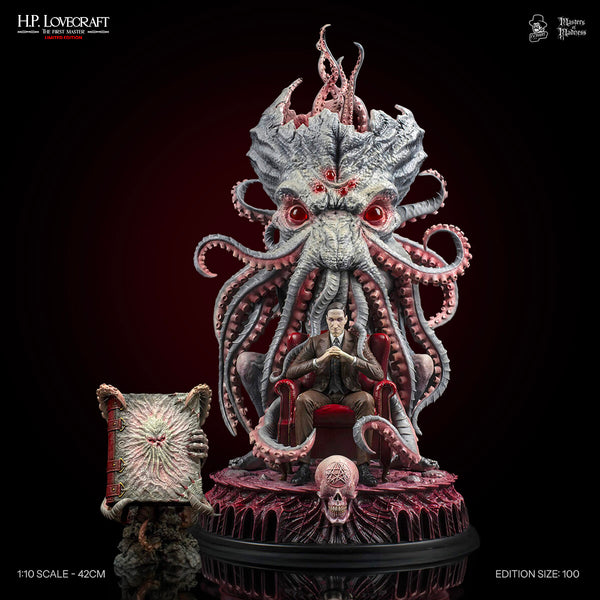
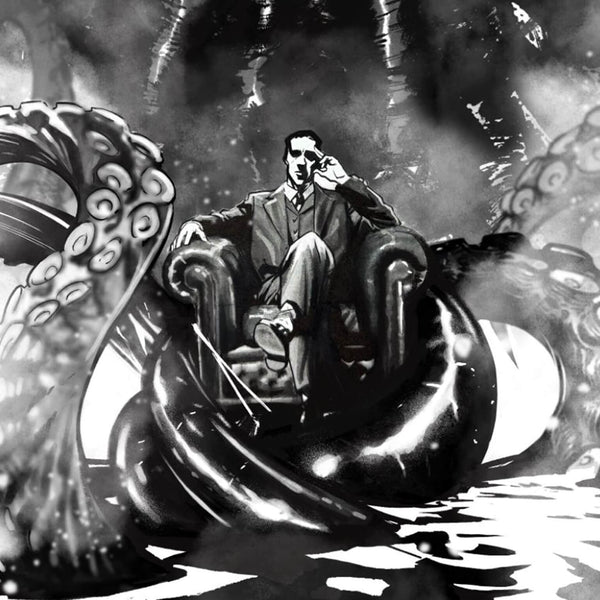
Studio Everart's Masters of Madness Chapter I takes precisely this approach: the statue depicts Lovecraft himself, not his creatures — the writer in the act of creation, surrounded by the artifacts of the mythology he built in isolation and poverty and genius.
What the Serious Mythos Collector Focuses On
The collector who understands the Mythos collects differently from the casual buyer. Key principles:
Depth over breadth. A collection of fifty generic Cthulhu figures communicates less than three carefully chosen pieces that engage with different aspects of the Mythos — the cosmology, the author, the texts.
Context matters. A piece of Mythos art means more when you understand what it represents. The Necronomicon is not just a prop. It is the fictional text that holds more knowledge about the Mythos entities than any character in Lovecraft's fiction dares to read. A replica that understands this — that builds its design around the weight of that fictional significance — is categorically different from one that is simply replicating a visual.
Long-term vs. short-term. The Cthulhu Mythos has been expanding for nearly a century. The writers and artists who engage with it seriously — and the collectors who preserve those engagements — are participating in a cultural project with genuine historical momentum. Collect accordingly.
H.P. Lovecraft: The Forbidden Edition
100 copie numerate. Artigianato italiano. IP originale.