Cthulhu: The Cosmic Abyss — Inside R'lyeh, Where Geometry Does Not Exist
On April 16, 2026, for the first time, R'lyeh became explorable.
Not a romanticized version, not a generically "Lovecraftian" setting. Cthulhu: The Cosmic Abyss, the new game from French studio Big Bad Wolf, takes the player exactly where none of Lovecraft's protagonists survived for long: inside the sunken city, among its impossible architectures, under the weight of Cthulhu's influence. Available on PC, PlayStation 5 and Xbox Series X, it is one of the most anticipated titles in the Lovecraftian community in recent years — and one of the most discussed.
The Year Is 2053. The City Is Ancient
The premise has the quality of a well-crafted nightmare. We are in the near future: Earth's surface resources have been exhausted, and megacorporations have moved the extraction industry to the ocean floors. When a mining station in the Pacific suddenly stops responding, Noah — an Interpol agent specializing in occult investigations — is tasked with finding out what happened.
Going down is easy. Coming back up is another matter.
What Noah finds is neither a technical malfunction nor an industrial accident. It is R'lyeh: Cthulhu's cosmic prison, the city Lovecraft described as built according to non-Euclidean geometry, with architectures that defy the laws of physics and passages that twist according to a logic the human mind can intuit but not formulate. Setting the game in 2053 is not a concession to modernity — it is a way of saying that R'lyeh does not belong to the past. It was always there. Waiting.
Key: The Artificial Intelligence in the Abyss
Accompanying him on this descent is Key, an artificial intelligence implanted directly into Noah's neural system. Not a voice assistant, not a talking map: a fully realized character, with her own narrative presence and concrete gameplay functions.
Key analyzes the chemical composition of objects, sends pulses through the area to locate materials, and interprets clues that Noah alone could not process. But her presence also introduces the game's most original thematic layer: what happens when a perfectly rational system — designed to analyze, classify, solve — finds itself immersed in the cosmic irrationality of the Lovecraftian universe?
Can an AI understand Cthulhu? The answer The Cosmic Abyss suggests, across its eighteen hours of gameplay, is more disturbing than the question.
How to Play: Exploration, Investigation, Madness
The Cosmic Abyss is not an action game. There are no weapons to wield, no battles to win. The enemies that inhabit R'lyeh are avoided, not confronted. The terror is environmental, psychological, built centimeter by centimeter through exploration.
The heart of the gameplay is investigation: every location is dense with interactive objects, hidden documents, annotations and cosmic artifacts that, collected one by one, reconstruct the story of what happened at the station and what lies hidden beneath. Noah organizes his thoughts through the Vault — a system inspired by the concept of a memory palace — where he connects gathered clues, opens otherwise inaccessible narrative branches and unlocks new analytical capabilities.
Marking the rhythm are environmental puzzles: enigmas requiring observation, logic and a mind still stable enough to reason. Because Noah's mind does not stay that way for long.
Madness manifests through the gameplay itself. Cthulhu's influence and contact with R'lyeh's cosmic abominations progressively degrade the protagonist's psychological health — and this is not reflected only in visual effects: it changes how Noah perceives the environment, modifies his analytical capabilities, and opens and closes narrative possibilities. The progression system is tied to exploration: the more curious and willing to venture deeper you are, the more powerful you become — but the more exposed you are to phenomena of cosmic instability that make the surrounding reality increasingly unreliable.
The Atmosphere: Faithful to the End
Where The Cosmic Abyss leaves no room for doubt is in its atmosphere. The underwater setting of R'lyeh is built with rare coherence: references to Dagon, The Shadow Over Innsmouth, The Night Ocean and The Call of Cthulhu emerge organically, without being flaunted. The architecture of the city obeys that impossible logic Lovecraft described without ever illustrating — and the game translates it into navigable space with genuinely disorienting results.
The soundtrack — over an hour of original music — completes the sonic architecture. Not generic horror: compositions that seem to come from a harmonic system partially different from our own, familiar enough not to be rejected, alien enough not to be forgotten.
Those who love Lovecraft deeply will find here a setting of rare effectiveness. The game does not hold your hand — deliberately — and for those accustomed to the prose of the Providence writer, this will be a virtue, not a flaw.
Prices and Editions
Cthulhu: The Cosmic Abyss is available on Steam starting at €39.99. The R'lyeh Edition — at €49.99 on PC, €59.99 on console — includes a 50-page digital artbook and an exclusive scenario for the Arkham Horror tabletop roleplaying game. For those who take the mythology seriously, the artbook alone is worth the attention.
R'lyeh in Digital and in Polystone
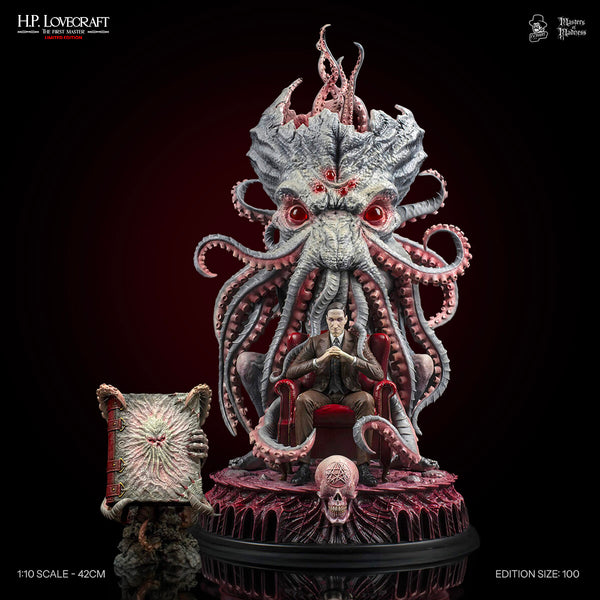
There is something compelling about playing The Cosmic Abyss with a statue of H.P. Lovecraft on the shelf beside the screen. It is not nostalgia — it is layering. The game takes you inside the myth: makes it navigable, interactive, subject to the player's decisions. The statue does something different: it makes it present. Physical. Numbered.
These are two ways of owning the same thing. The Forbidden Edition by Studio Everart — 42 centimeters of hand-painted polystone, 100 numbered pieces worldwide, almost sold out — exists in exactly that space video games cannot occupy: the space of permanent, silent presence, without an interface.
The Cosmic Abyss was released on April 16, 2026. The statue is already here.
Studio Everart produces limited edition statues inspired by horror literature and Lovecraftian mythology. The Forbidden Edition — H.P. Lovecraft, 1/10, 42 cm, 100 pieces worldwide — is available for pre-order at studioeverart.com.

100 numbered pieces. Hand-painted. An original Studio Everart design.
€700,00 €760,00 View H.P. Lovecraft: The Forbidden Edition