From Pulp Fiction to Premium Collecting: The Lovecraft Trajectory
Howard Phillips Lovecraft died in 1937 with approximately thirty dollars in the bank, owing money to his landlord, survived by a handful of friends and a small circle of amateur fiction writers who had corresponded with him for years.
By any conventional measure, his life was a failure.
Today, a first edition of The Shadow Over Innsmouth (1936) — the only book published during his lifetime — sells for tens of thousands of dollars at auction. The mythology he created has generated billions in cultural value across gaming, cinema, literature, and visual art. And the fine art market for Lovecraft-inspired works — from limited edition polystone statues to original paintings by established artists — has grown into a distinct and serious collecting category.
This trajectory — from pulp obscurity to premium cultural status — is not accidental. It follows a pattern that collectors of dark art recognize: the ascent of the genuinely transgressive into the permanently significant.
What Makes Lovecraft Collectible Art, Not Merchandise
There is a distinction that every serious collector understands, even if they rarely articulate it: the difference between merchandise and art.
Merchandise is produced to satisfy demand for a recognizable image. It is efficient, predictable, and interchangeable. A Cthulhu keychain and a Cthulhu coffee mug are merchandise. They say: "I recognize this reference."
Art — including fine collectible art — is produced to say something about the subject. It interprets, elevates, or reveals. It requires a genuine creative relationship between the maker and the material. It is not interchangeable, because the maker's choices — the composition, the materials, the concept — are specific and deliberate.
When a piece of Lovecraft-inspired art reaches the level of genuine craft — numbered edition, named sculptor, documented production process, premium materials — it crosses from merchandise into a different category. It becomes a statement about Lovecraft's place in cultural history, not just a reproduction of his iconography.
The Aesthetic Problem: Why So Much Lovecraft Art Fails
The majority of Lovecraft-inspired collectible art fails for the same reason: it reduces a complex philosophical system to its most superficial elements. Tentacles. Eyes. Green. Octopus-head.
This is the aesthetic equivalent of representing Kafka through a giant insect, or Borges through a labyrinth. The symbol is present. The meaning has vanished.
The collectors who understand Lovecraft at a deeper level are not satisfied by tentacles. They are looking for work that engages with the actual substance of his contribution: the philosophical premise of human insignificance, the biographical tragedy of the man who built a universe that the world would discover only after his death, the specific aesthetic of dread — not shock, not gore, but the slow horror of comprehending how small you actually are.
The Artist's Responsibility: Studio Everart's Approach
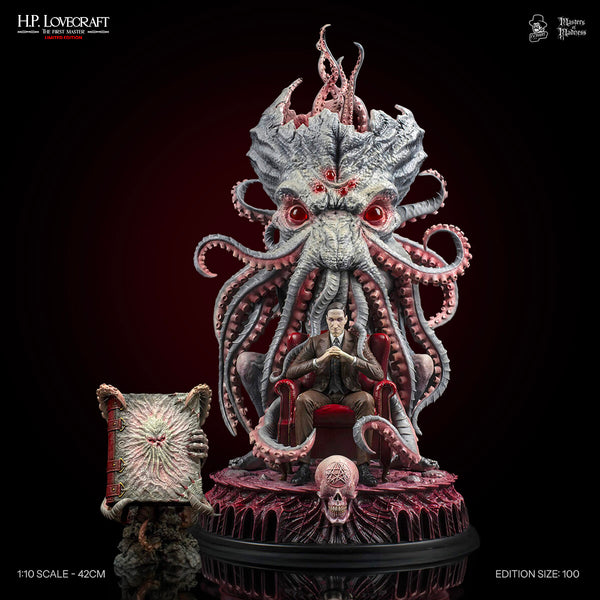
When Studio Everart designed the Masters of Madness Chapter I statue, the central question was not: "Which Mythos entity should we sculpt?" It was: "What moment, in Lovecraft's biography or mythology, is genuinely worthy of the collector's permanent attention?"
The answer: Lovecraft himself. The writer. The man in the act of creation — building a mythology that he would never see recognized, in a room in Providence, Rhode Island, surrounded by books and correspondence and the kind of obsessive detail that only someone with nothing to lose produces.
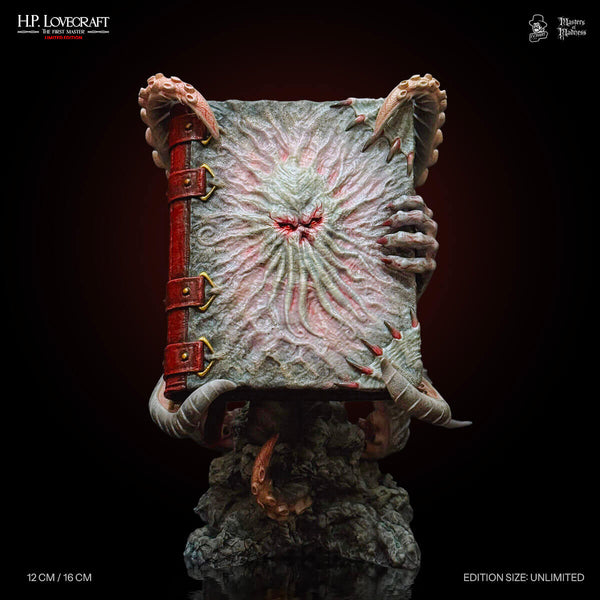
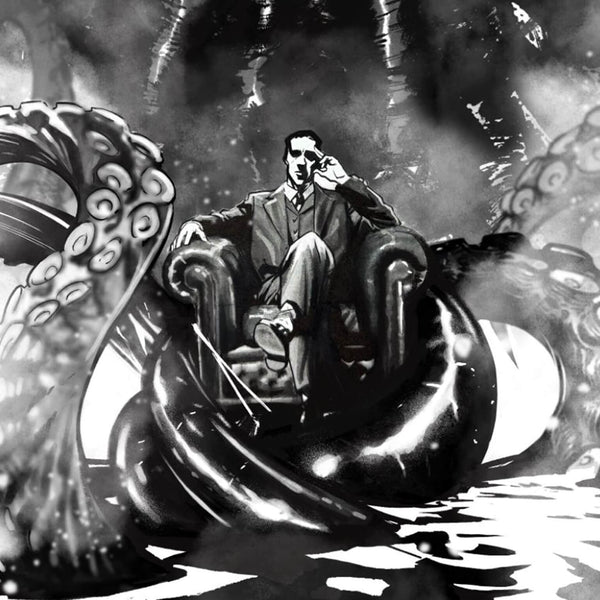
That is the subject. Two interchangeable heads (Madness and Consciousness), a 12cm Necronomicon replica in resin, an original art print by Francesco Manna — not accessories, but interpretive choices that extend the central concept.
Over 200 hours of production. Sculpted by Giacinto Platania and Simona Bordonaro. 42cm in polystone. 100 pieces, numbered, never to be reproduced. That specificity is what separates fine collectible art from merchandise.
The Long View: Lovecraft's Place in Art History
The serious collector thinks in decades. The question is not "what is Lovecraft's cultural status in 2026?" It is "what will Lovecraft's cultural status be in 2046?"
The evidence is encouraging. The Cthulhu Mythos is now almost a century old and shows no signs of cultural contraction. Academic study of Lovecraft has intensified. His influence on established literary figures — Jorge Luis Borges, Thomas Ligotti, Jeff VanderMeer — is thoroughly documented. The gaming, cinema, and visual art industries that draw on his mythology represent a multi-billion dollar creative economy.
Lovecraft is not a trend. He is a permanent feature of the cultural landscape — one of the handful of 20th century writers who created something genuinely new and genuinely lasting. Collecting his mythology seriously is collecting a position in that permanence.
H.P. Lovecraft: The Forbidden Edition
100 copie numerate. Artigianato italiano. IP originale.