The Paradox of Lovecraft's Fame
Few cultural figures have experienced a more extreme posthumous reversal than Howard Phillips Lovecraft. In his lifetime: obscurity, poverty, critical indifference. In the century since his death: a mythology that has penetrated every significant entertainment medium on the planet.
Stephen King has called him "the 20th century's greatest practitioner of the classic horror tale." Jorge Luis Borges cited him as a major influence. Neil Gaiman, Thomas Ligotti, Jeff VanderMeer — the lineage of literary writers who acknowledge a debt to Lovecraft is long and serious. The tabletop RPG Call of Cthulhu (1981) has sold millions of copies and introduced the Mythos to generations who have never read the original stories. Bloodborne — one of the most critically acclaimed video games in history — is an extended meditation on Lovecraftian themes.
This is not a niche. This is a mythology.
Why Providence? Why This Particular Recluse?
There are hundreds of horror writers in American literary history. Most are forgotten. Lovecraft, who by any commercial measure was among the least successful of them, is the one who survived. Understanding why matters for the collector who wants to understand what they are investing in.
The answer lies in the nature of his innovation. Most horror writers worked within established frameworks — the ghost story, the monster narrative, the dark fairy tale. Lovecraft created something that had no precedent: a cosmological horror, in which the source of dread was not a specific creature or event, but a philosophical premise about the nature of reality itself.
That premise — that humanity is insignificant within a universe populated by entities so alien and so indifferent that we cannot even register as threats — is more resonant today than it was in 1926. Every new space telescope image, every quantum physics breakthrough, every climate model that shows the indifference of geological time to human civilization confirms the emotional logic of Lovecraft's horror.
He did not create monsters. He created a framework for understanding why the universe is frightening. That framework has proven extraordinarily durable.
The Collecting Case: What Lovecraft's Legacy Means for Your Collection
When a serious collector acquires a piece of Lovecraft-adjacent fine art, they are making a statement about durability. They are saying: "This mythology has been growing for a century, and I believe it will continue to grow."
That belief is supported by evidence that is unusual in the collectible market. Most horror collectible subjects are tied to specific media properties — films, game franchises — that age and lose cultural relevance. Lovecraft's mythology is tied to a philosophical premise that ages in the opposite direction: the more science reveals about the actual scale and indifference of the universe, the more viscerally relevant cosmic horror becomes.
The collector who acquires a serious Lovecraft piece in 2026 is acquiring a position in a mythology that is, structurally, unlikely to lose cultural relevance in their lifetime. That is a remarkably unusual claim to make about any collecting subject.
The Studio Everart Position
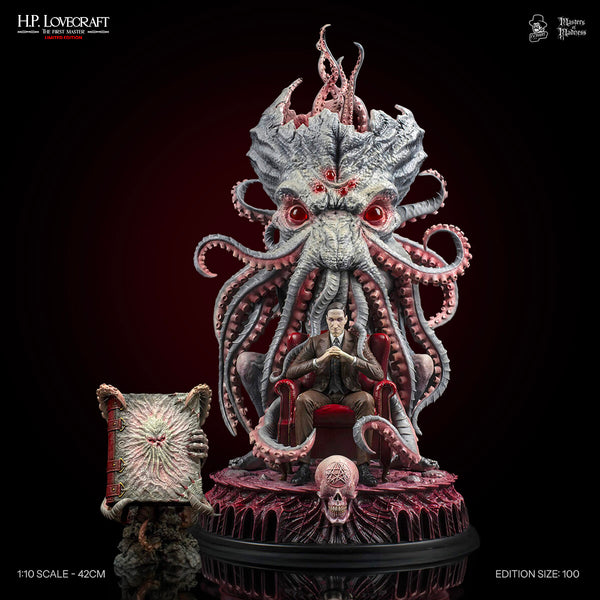
The Masters of Madness collection was designed with this long view in mind. Chapter I honors Lovecraft not as a creature vendor but as a literary figure — the man whose biography (isolated, driven, obsessive, brilliant) is as compelling as the mythology he produced.
100 pieces. Named sculptors. Numbered certificates. Never to be reproduced.
In a market flooded with mass-produced Cthulhu merchandise, a piece that treats Lovecraft with the seriousness his legacy deserves is not just aesthetically superior. It is strategically positioned within a mythology whose cultural trajectory has been consistently upward for nearly a century.
That trajectory is the collecting case. It is a strong one.
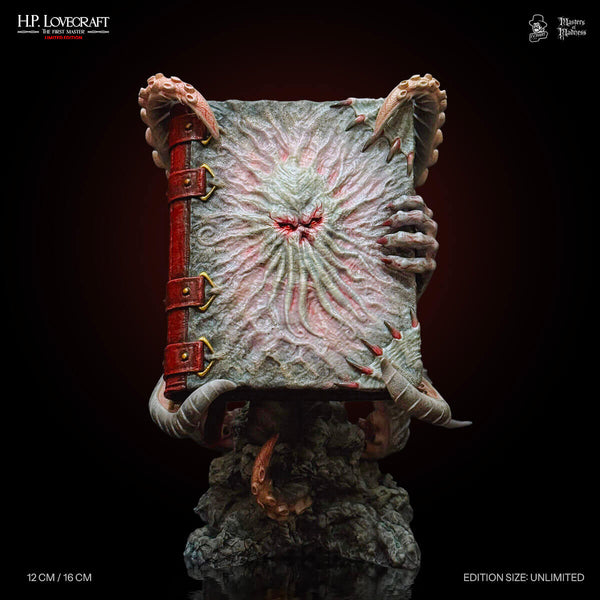
That legacy takes physical form in the Forbidden Edition Lovecraft statue.
H.P. Lovecraft: The Forbidden Edition
100 copie numerate. Artigianato italiano. IP originale.