MASTERS OF MADNESS · CHAPTER II
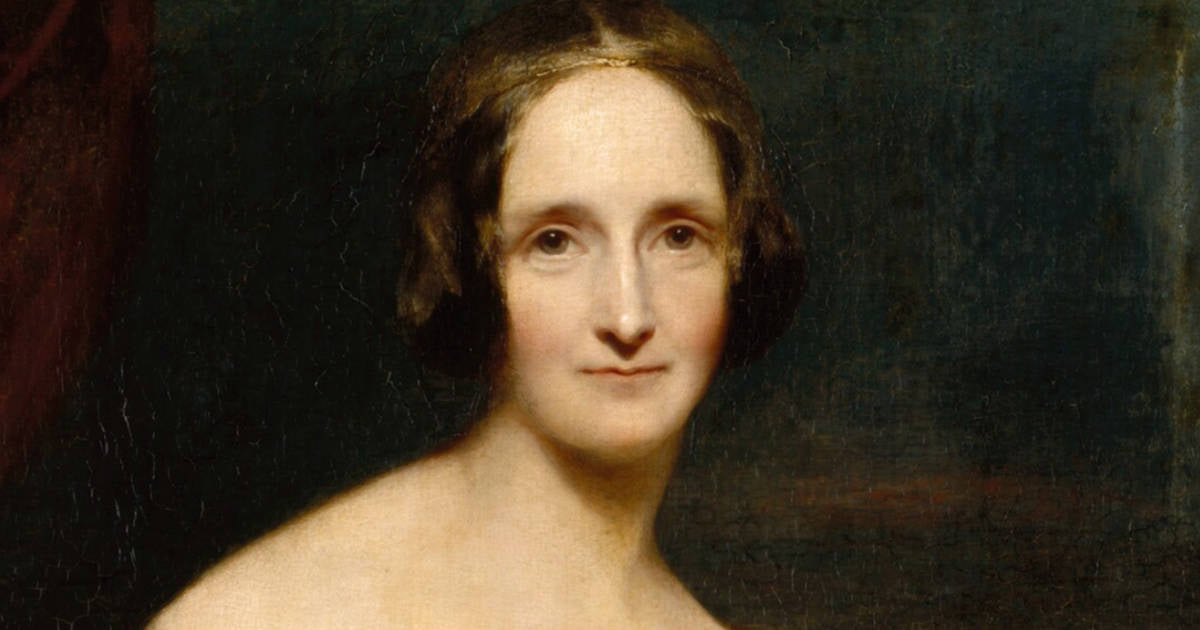
Mary Wollstonecraft Shelley
1797 – 1851 · London, England
"Beware; for I am fearless, and therefore powerful." — Frankenstein; or, The Modern Prometheus, 1818
INTRODUCTION — THE WHY
Mary Shelley was eighteen years old when she wrote the book that would found modern science fiction.
It was not a school exercise. It was not a whim. It was the answer of an eighteen-year-old girl, already a mother and already grieving a lost child, to the oldest question of humanity: what happens when you create something you cannot control?
Frankenstein; or, The Modern Prometheus is not the story of a monster. It is the story of a man who wanted to play God — and discovered that the creator's guilt is permanent, that abandonment does not go unpunished, that the abandoned creature always returns.
In almost two centuries of literature and cinema, no one has improved on this idea. They have only spun variations of it.
Studio Everart chose Mary Shelley as Chapter II of the Masters of Madness collection because her contribution to horror is not an iconic monster — it is a question that still has no answer. And a woman who had the courage to ask it at eighteen, in a world that did not expect women to ask questions of this kind.
THE WOMAN — BIOGRAPHY
The Woman
Born into tragedy. She turned grief into permanent literature.
Mary Wollstonecraft Godwin was born in London on 30 August 1797. Her mother, Mary Wollstonecraft — philosopher and pioneer of feminism, author of A Vindication of the Rights of Woman — died eleven days after the birth. Mary grew up with the awareness that she had cost the life of the most important person she could have had.
Her father, William Godwin, was an anarchist and progressive philosopher. The house was full of ideas, of books, of intellectuals. But not of warmth. Godwin remarried, and the stepmother did not give Mary the same attention as her stepchildren. Mary learned early that the intellect was the territory in which she was most free.
At sixteen she met Percy Bysshe Shelley — already married — and fled with him to Europe, accompanied by her stepsister Claire Clairmont. It was a scandal. Mary did not care.
In 1815 she gave birth to a premature daughter who died after eleven days. Mary was seventeen. She dreamed of the dead child coming back to life, warmed by her hands. She wrote in her diary: "Dream that my little baby came to life again; that it had only been cold, and that we rubbed it before the fire, and it lived."
The following year, in the summer of 1816, she was in Switzerland with Percy, with Lord Byron, with Byron's physician John Polidori, and with Claire. It was the coldest summer of the nineteenth century — Tambora had erupted in Indonesia the year before, and its dust had blocked the sun across the northern hemisphere. The year without a summer. It rained constantly. No one could go outside.
Byron proposed a contest: each of them would write a horror story.
From that contest came two founding works of horror literature: Mary Shelley's Frankenstein and Polidori's The Vampyre — the direct precursor of Dracula.
Mary was eighteen. She had already lost a daughter. She had understood what it means to create something and be unable to protect it.
Percy died in 1822, drowned during a storm in the Gulf of La Spezia. He was thirty. Mary was twenty-four, with one surviving child out of four. She returned to England. She kept writing — novels, biographies, essays — for the rest of her life. But the world would remember only Frankenstein.
She died in 1851, at fifty-three, probably of a brain tumour. She was buried with the remains of Percy's heart — kept in a wrapping of silk from the day of his death.
THE WORK — KEY TEXTS
The Work
A book written at eighteen. Two centuries of influence.
THE OBSESSION — HER RELATIONSHIP WITH DARKNESS
The Obsession
She did not write about monsters. She wrote about the guilt of those who create them.
The question at the heart of Frankenstein is not "is it possible to create life?" It is "what does it mean to abandon what you have created?"
Victor Frankenstein is not a villain. He is something more precise and more unsettling: a brilliant man who has the courage to do something impossible and not the courage to face its consequences. He creates a sentient being, capable of love and hatred, of learning and suffering — and then flees, horrified, because the creature is ugly.
The creature is not a monster. In the original novel, it is the most articulate and most sympathetic character: it learns to read by secretly watching a peasant family, it feeds on berries so as not to take food from the humans it observes, it asks only to be understood. It is its exclusion — systematic, violent, final — that turns it into something destructive.
Mary Shelley had lived abandonment on both sides. She was the daughter of the dead mother — the abandoned creature. She was the mother of the dead child — the powerless creator. Frankenstein is not a work of fantasy. It is an act of mourning, disguised as a Gothic novel.
Mary Shelley's relationship with darkness is different from Lovecraft's: it is not cosmic, not nihilistic. It is human, painfully human. Her greatest fear is not the unknown — it is responsibility. The possibility of creating something alive and not being equal to what you have created.
In this sense, Frankenstein is the horror novel closest to everyday experience — because anyone who has ever had children, students, ideas, companies, relationships — anyone who has ever created something — has felt, at least once, the terror of Victor Frankenstein.
THE LEGACY
The Legacy
Founder of two genres. Forgotten for nearly a century.
Mary Shelley founded two literary genres: modern science fiction and dystopian fiction. The Last Man — her 1826 novel about a pandemic that wipes out humanity — anticipates the masterpieces of the post-apocalyptic genre by a century and a half.
Frankenstein inspired everything. Boris Karloff in 1931. Kenneth Branagh in 1994. Blade Runner — where the creator of replicants must confront his creations. Ex Machina. Frankenstein's themes are so pervasive in modern fiction that we often no longer recognise them as such: every story of an artificial intelligence that develops its own consciousness is Frankenstein. Every story of a being that asks to be recognised by the society that created it is Frankenstein.
And yet for nearly a century the novel was attributed to Percy Shelley, or considered a work of circumstance — the lucky answer of a girl to a parlour game.
Only in the twentieth century did critics begin to read Frankenstein for what it is: one of the most complex, most personal, and most prophetic novels ever written in the English language.
WHY WE CHOSE HER — STUDIO EVERART
Why We Chose Her
The courage to ask the wrong question at the wrong age at the wrong moment.
Horror collecting is full of Frankenstein. Of monsters, of stitched-together corpses, of bolts in the neck. There is almost no depiction of Mary Shelley — the girl who invented all of it at eighteen, in a Swiss villa during a sunless summer, carrying within her the weight of a dead mother and a just-lost daughter.
This is the void we want to fill.
Mary Shelley is Chapter II of the Masters of Madness collection not because she is the most famous — Lovecraft as a brand is more immediately recognisable in the pop imagination. But because her question is the one that concerns us most: what does it mean to create something? What do you owe to what you bring into the world? What responsibility does the creator have toward their creation?
These are questions an artist asks every day. They are questions a studio like ours asks every time we work on a new piece.
Chapter II will be our answer.
THE STATUE — CHAPTER II (in development)
The Statue · Coming Soon
Chapter II — Mary Shelley. In development.
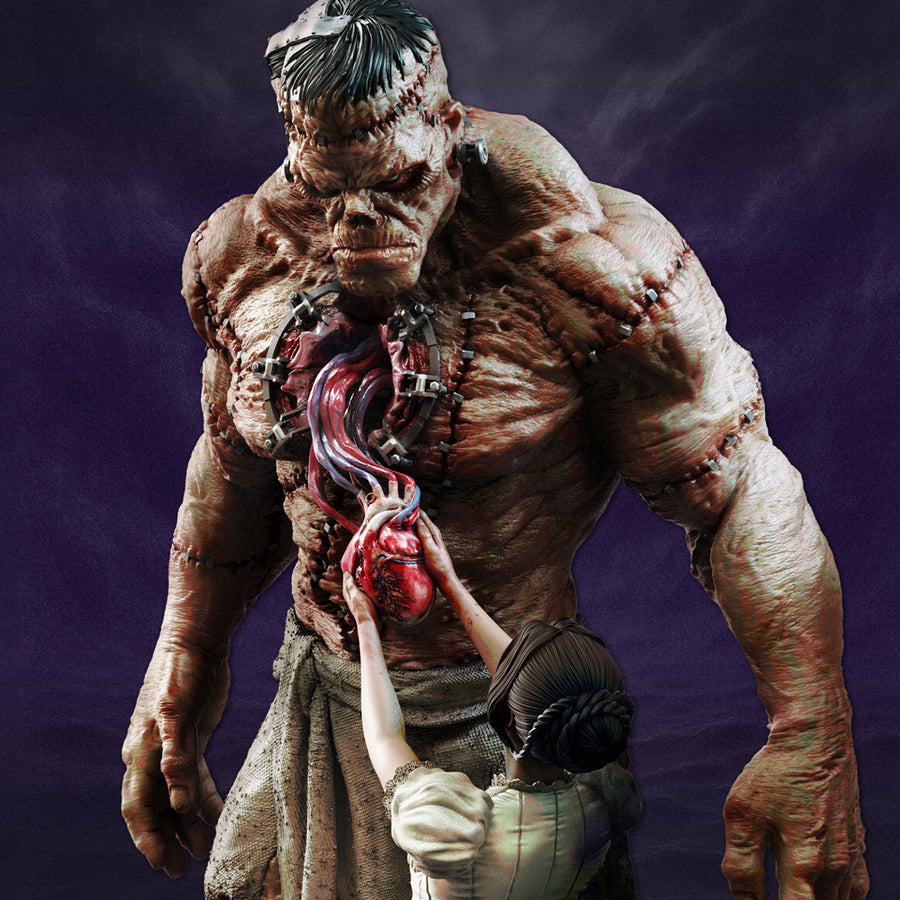
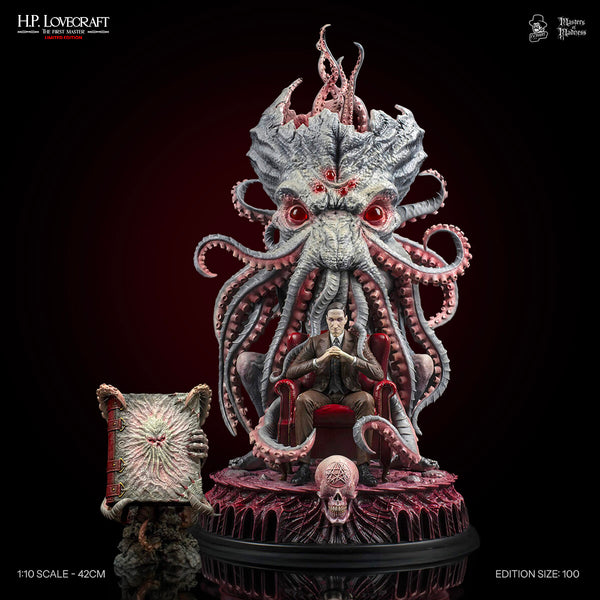
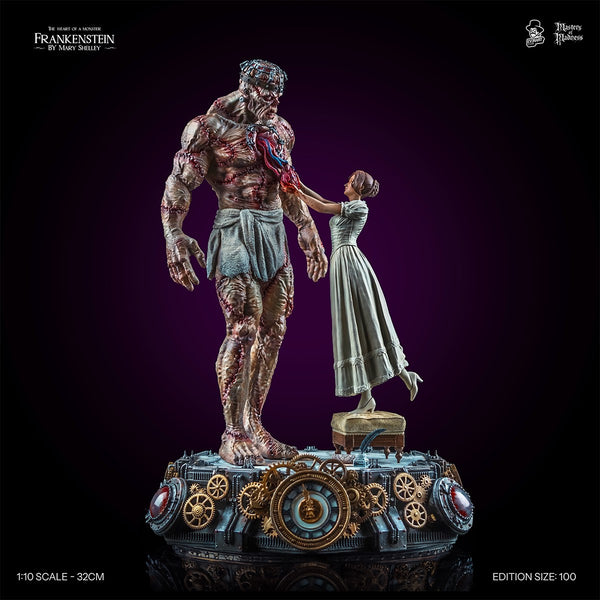
Chapter II is in active development. As with Lovecraft, the statue will not depict a character from the novel. It will depict Mary Shelley — the mind that asked the question.
The central narrative concept, the secondary object included in the bundle, and the art print are being defined. Collectors subscribed to the newsletter will be the first to know.
Join the list — early access