MASTERS OF MADNESS · CHAPTER III
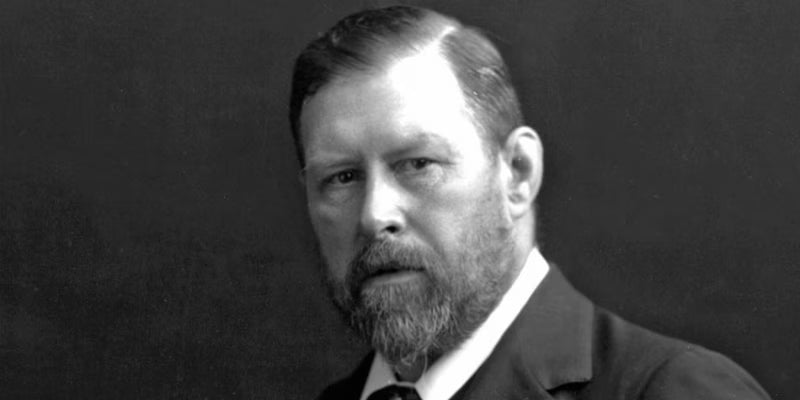
Abraham "Bram" Stoker
1847 – 1912 · Dublin, Ireland
"There are mysteries which men can only guess at, which age by age they may solve only in part." — Dracula, 1897
INTRODUCTION — THE WHY
Bram Stoker did not write a horror novel. He wrote a manual of power.
Dracula is not frightening because he drinks blood. He is frightening because he does not age while everyone around him burns out. Because he crosses the borders others cannot cross. Because he seduces, controls, consumes — and never suffers the consequences that the moral law of the age would have imposed on anyone else.
Stoker spent twenty years in the shadow of Henry Irving — the most famous actor of the Victorian era, the first in history to be knighted for artistic merit. Stoker was his manager, his secretary, his executor in everything. A brilliant man who gave the best of his career to a genius who rarely thanked him, who ignored him for months, who called on him when he needed him and forgot him when he did not.
Anyone who reads Dracula after understanding this relationship can never read it the same way again.
Studio Everart chose Bram Stoker as Chapter III of the Masters of Madness collection because his story is the story of power seen up close — its seduction, its violence, and how hard it is to resist something that fascinates you while it consumes you.
THE MAN — BIOGRAPHY
The Man
He lived in the shadow of a giant. He created a character greater than both of them.
Abraham Stoker was born in Dublin on 8 November 1847, the third of seven children. As a child he was chronically ill — for the first seven years of his life he was almost always bedridden, unable to walk. The cause was never established with certainty. Then he recovered. He became an excellent student at Trinity College Dublin, then an athlete — a champion in football, athletics, and swimming.
He worked as a civil servant at Dublin Castle for years, writing about theatre in his spare time out of pure passion. He was a brilliant, respected, unpaid critic.
In 1876 he attended a performance of Henry Irving's Hamlet at the Theatre Royal in Dublin. Irving had such an extraordinary stage presence that Stoker burst into tears after the show. They were introduced. They became friends.
In 1878 Irving invited him to London to run his theatre, the Lyceum — the most prestigious in England. Stoker left everything. He accepted.
For twenty-seven years — from 1878 until Irving's death in 1905 — Bram Stoker was not Bram Stoker. He was "Irving's manager". He ran the theatre, the tours, the contracts, the crises, the whims. He wrote letters, organised events, solved problems. He answered thousands of requests every week. Irving treated him as an indispensable tool — as valuable as a fine watch, and with about the same capacity for feeling.
During this period Stoker wrote. Novels, stories — nothing particularly notable. Then, in 1890, he began taking notes for a story about a vampire from Transylvania. He studied for seven years: the folklore of Eastern Europe, the history of Wallachia, the psychology of seductive evil.
Dracula was published in 1897. Irving never read it in full. Or at least never admitted to it.
Irving died in 1905, struck down by a stroke shortly after a performance. He left everything to his sons, not a penny to Stoker. Bram spent his final years in financial hardship. He died in 1912, probably of a stroke — though some historians suggest damage from syphilis, or simply the exhaustion of a man who had given everything to someone who never gave it back.
HENRY IRVING — THE KEY TO DRACULA
The Shadow
To understand Dracula is to understand Henry Irving.
Henry Irving was everything Dracula is in the novel.
He was irresistible. His performances were social events — people waited months for a ticket. Gladstone, the Prime Minister, attended his premieres. Tennyson wrote about him. The critics treated him as a force of nature, not as an actor.
He was dominant. The Lyceum's decisions were his — Stoker carried them out. The tours lasted months and Stoker organised them down to the smallest detail, from transporting the costumes to booking hotels for forty people. Irving appeared, performed, vanished. The work was Stoker's.
He was consuming. Stoker worked twelve, fourteen hours a day. At the Lyceum's peak he simultaneously ran the theatre, the American tours, the correspondence with a thousand different people, and tried to find time to write. His first stroke struck in 1906 — a year after Irving's death. The body settled the account of decades.
Stoker never explicitly stated that Irving was the model for Dracula. But he never denied it either. And in his preparatory notes — kept at the Rosenbach Foundation in Philadelphia — some of the Count's traits seem tailored to one specific man.
THE WORK — KEY TEXTS
The Work
A single book that changed everything. Forever.
THE OBSESSION — HIS RELATIONSHIP WITH DARKNESS
The Obsession
Not madness. Power. Its seduction. Its cost.
Stoker's relationship with darkness is the most sophisticated of the three authors in the collection — and the hardest to put into words.
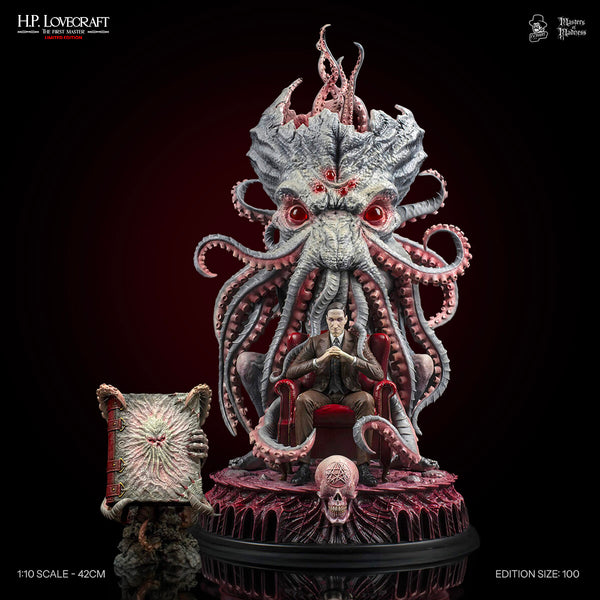
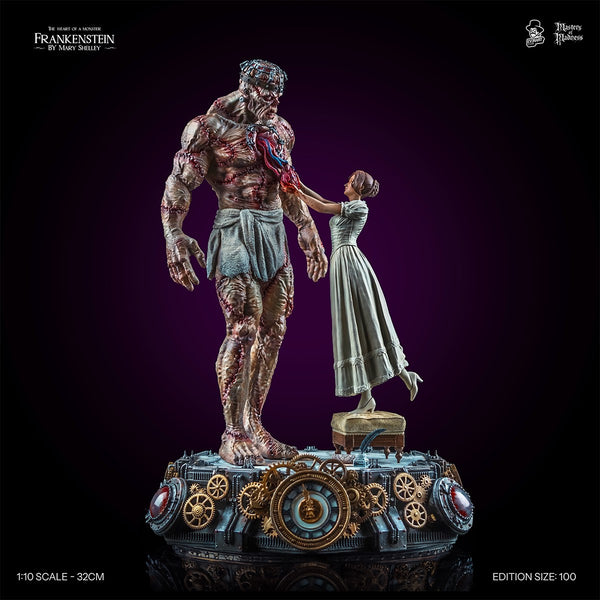
Lovecraft feared the unknown. Shelley feared the responsibility of creation. Stoker feared something closer and more everyday: power in the hands of someone who does not play by the same rules as everyone else.
Dracula is not a monster in the literal sense of the word — not in the original novel. He is an aristocrat of extraordinary intelligence, culture, and presence. He speaks the languages of Europe fluently. He knows England's history better than the English. He has supernatural physical abilities. And he is entirely above the law — the Victorian moral law that governed every aspect of the lives of the characters who face him does not apply to him.
This is Stoker's fear. Not the blood. Privilege without limits.
There is something painfully honest in the fact that Stoker wrote the most charismatic character in horror literature while working for a man who ignored him.
We do not know whether Irving recognised himself in Dracula. We know that Stoker never spoke to him about it.
Stoker's relationship with madness is not Lovecraft's cosmic paranoia or Shelley's terror of grief. It is the clarity of someone who watched power work up close, understood how it works, and turned it into literature precisely because he could not name it any other way.
THE LEGACY
The Legacy
The vampire who created every vampire.
Before Dracula, the vampire in the literary tradition was a folkloric creature, primitive, without personality. Polidori's The Vampyre — written at the Villa Diodati contest in the same year Mary Shelley conceived Frankenstein — had introduced the idea of the aristocratic vampire, but it had remained a short story, a sketch.
Stoker built the complete system. The castle in Transylvania. The rules — the invitation, the reflection in the mirror, the stake, the garlic, the dawn. The powers. The psychology. Sexual allure fused with absolute violence. Everything we associate with the vampire today — in literature, cinema, video games, television — comes from Dracula.
Bela Lugosi in 1931. Christopher Lee in the 1960s and 70s. Gary Oldman in 1992. Robert Pattinson in 2008. Anne Rice, with her Vampire Chronicles, built an entire universe within Stoker's rules while claiming only partial influence from him. True Blood. What We Do in the Shadows. Interview with the Vampire. Buffy.
Dracula is the most adapted horror character in the history of cinema — with over a thousand documented adaptations, he surpasses even Sherlock Holmes in the number of film versions.
WHY WE CHOSE HIM — STUDIO EVERART
Why We Chose Him
The man who saw power from the inside — and turned it into literature.
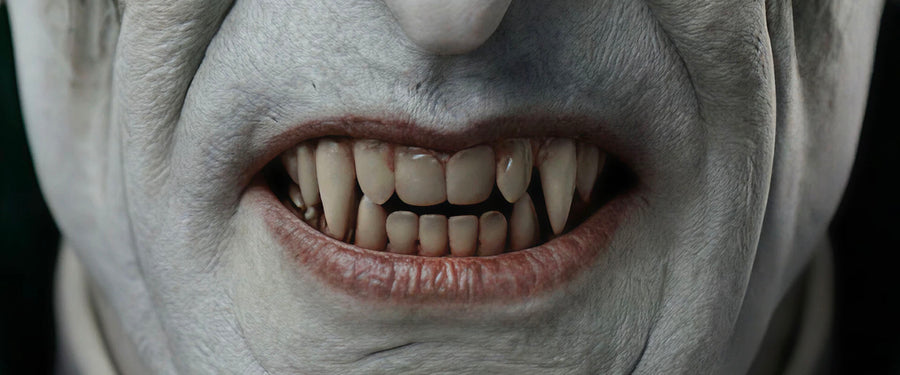
Horror collecting has given Dracula every possible form. The cape, the fangs, the castle. It has built an entire economy around Stoker's creature.
It has never made a statue of Stoker.
That is the point. Bram Stoker is the man behind the most powerful archetype of power in modern fiction — and no one has ever honoured him as a subject. As a mind. As a person with a story that explains why that story rings so true.
Chapter III of the Masters of Madness collection will be our answer to that absence.
The statue will not depict Dracula. It will depict Stoker — the man who for twenty years watched power work up close, who understood how seduction turns into consumption, and who found in the Gothic the only language capable of saying what he could not say any other way.
THE STATUE — CHAPTER III (in development)
The Statue · Coming Soon
Chapter III — Bram Stoker. In development.
Chapter III is in active development. The statue, the secondary object in the bundle, and the art print are being defined. As with Lovecraft and Shelley, the subject will be Stoker — not his character, but the man.
Collectors subscribed to the newsletter will be the first to know when Chapter III is officially announced.
Join the list — early access