You've read about Cthulhu. You know the story — the sunken city of R'lyeh, the cosmic indifference, the thing that waits at the bottom of everything. You understand why it works as a concept and why Lovecraft's 1926 story has outlasted virtually everything written around it.
But there's a gap between knowing the myth and living with it. This piece is about what collectors who are equally obsessed actually have on their shelves — and what separates a serious collection from a drawer full of novelty merchandise.
Cthulhu Merchandise vs Cthulhu Collectibles
The Cthulhu licensing market is enormous and almost entirely comprised of merchandise: plush toys, enamel pins, keychains, phone cases, mugs. These exist because the image is recognizable and the IP is public domain — anyone can produce them, and most do.
Collectors who take the Mythos seriously don't buy this category. Not out of snobbery — out of the same logic that separates a poster from a print. The question isn't whether Cthulhu is on the object. It's whether the object treats Cthulhu with the same weight the concept deserves.
What serious collectors look for is different in three specific ways:
- Interpretation over reproduction. The best Cthulhu collectibles don't copy a specific film or game version. They interpret the literary source — Lovecraft's own descriptions, which are deliberately incomplete and designed to force the imagination to fill in what's wrong.
- Material permanence. Polystone, cold cast resin, hand-painted finishes. Objects with weight and texture that signal they were made to last decades, not months.
- Scarcity that's real. An edition of 100 numbered copies is different from a print run of 50,000 units. The number matters because it changes what you're actually possessing.
What's Actually on Serious Collectors' Shelves
Across collector communities — CollectorFreaks, Reddit's r/Lovecraft, horror art forums — a pattern emerges. The pieces that appear repeatedly in serious collections share the same qualities: they were made by someone who read the source material, not someone who licensed a recognizable silhouette.
Sculptures occupy the top tier. Not because sculpture is inherently superior to other forms, but because a three-dimensional object in a space does something a print or a screen can't: it holds the room. A Cthulhu sculpture that's right — that captures the specific wrongness of something almost-humanoid but fundamentally not — changes the atmosphere of the space it occupies. Collectors describe this as the difference between decorating and curating.
The Author Behind the Creature
Here's what many collectors eventually discover: the creature is downstream of the man. Cthulhu exists because H.P. Lovecraft had a specific relationship with fear — cosmic, impersonal, rooted in the conviction that the universe contains things the human mind was not built to process. Every tentacle, every sunken city, every sanity roll in a Call of Cthulhu session traces back to that one obsession.
Which is why serious Lovecraft collectors often end up not with Cthulhu on their shelf, but with Lovecraft himself. The author as the artifact. The source, not the product.
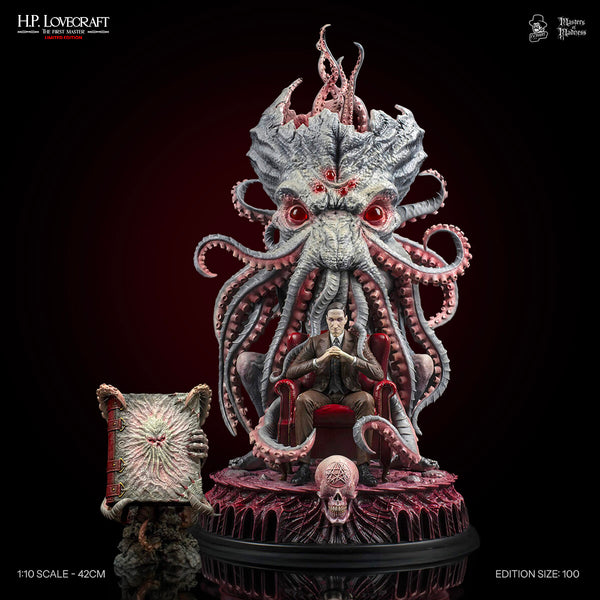
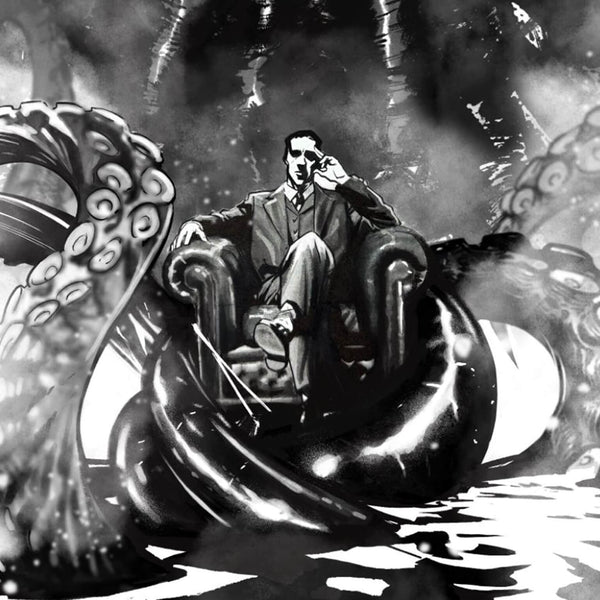
The H.P. Lovecraft Master — the first piece in the Masters of Madness collection — was built from that logic. Hand-painted polystone, 100 numbered copies, original sculpt. Lovecraft as the literary figure: the writer sitting at his desk in Providence, the man who invented the Mythos before anyone knew what the Mythos was.
If you love Cthulhu, the creature, you already know where it comes from. This is where it comes from.
The H.P. Lovecraft Master — 100 numbered copies. See the collection →
Frequently Asked Questions
What Cthulhu collectibles are worth buying?
Worth buying means different things to different collectors. If you want something that holds value and meaning over time, focus on limited-edition sculptural pieces with declared edition sizes and hand-finishing — not open-production merchandise. The Cthulhu market is flooded with cheap items; the genuine collector segment is much smaller and more specific about what "quality" means.
Is there a definitive Cthulhu statue?
No single piece has achieved canonical status the way certain film props or franchise pieces have — partly because Lovecraft's Cthulhu was deliberately left visually undefined. This is actually an advantage for collectors: the best pieces are interpretations, not reproductions, which means the sculptor's choices matter. Look for pieces where the sculptor has clearly engaged with the literary source, not just the popular image.
What do serious Lovecraft collectors actually collect?
Beyond Cthulhu specifically: annotated and collector's editions of the stories, original artwork and prints from illustrators working in the Mythos tradition, hand-painted sculptural figures of Mythos entities and Lovecraft himself, Call of Cthulhu RPG materials (especially older editions), and literary horror adjacent to Lovecraft — Clark Ashton Smith, Arthur Machen, Algernon Blackwood. The common thread is seriousness about the source material, not just the recognizable imagery.

100 numbered pieces. Hand-painted. An original Studio Everart design.
€700,00 €760,00 View H.P. Lovecraft: The Forbidden Edition