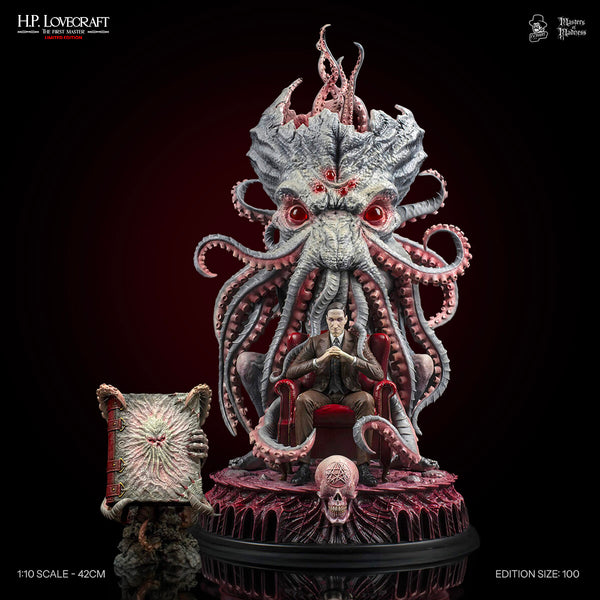
Most horror objects show a monster. Ours shows an idea. The Forbidden Edition does not put a creature on a base and call it finished. It stages a thought: the author absorbed into the thing he wrote. That is the difference between a figure and a piece of narrative sculpture.
The usual horror object
The market is full of creatures. A beast, a base, a price. They decorate a shelf and ask nothing of the viewer. They are fine. They are also interchangeable, because a monster without a concept is just a shape.
What we did differently
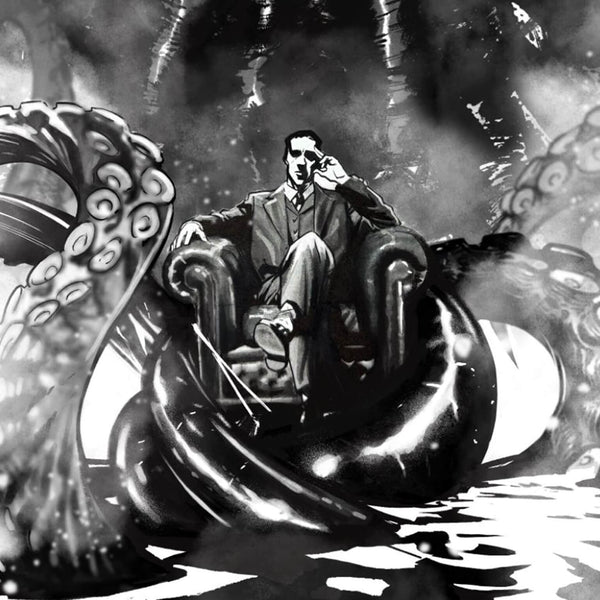
We made Howard Phillips Lovecraft the subject and let his fiction grow out of his own back. The figure reads as a portrait and a possession. The head opens like a cosmic egg onto an Azathoth-scale appetite. The piece argues that writing cosmic horror is a transformation, not a craft. You can read the full decoding in Decoding the Lovecraft Statue.
Made to be owned, not just displayed
The Forbidden Edition is hand-painted, numbered, and built in polystone in Italy. It ships with a sculpted Necronomicon. It is Chapter I of Masters of Madness, a series about the minds that built literary horror.
What you actually acquire
You acquire an interpretation. An artist read the work, found the premise underneath it, and gave that premise a body. Nothing else on the market makes the same argument, because the argument is the product. More context at the H.P. Lovecraft hub.
Lovecraftian glossary
- Limited edition
- A run produced in a fixed, small quantity.
- Numbered edition
- Each piece carries its own sequence number.
- Polystone
- Dense resin blend used for premium statues.
- Cosmic horror
- Fear built on human insignificance before an indifferent universe.
- Narrative sculpture
- A piece built to carry a story, not decoration.
Sources

100 numbered pieces. Hand-painted. An original Studio Everart design.
$756.00 $821.00 View H.P. Lovecraft: The Forbidden Edition