Who Was H.P. Lovecraft?
Howard Phillips Lovecraft (1890–1937) was an American writer from Providence, Rhode Island, whose work redefined the boundaries of horror fiction. In a career spanning barely two decades, he created a mythology so vast and so internally consistent that it has outlived him by nearly a century — and shows no signs of fading.
He was not famous in his lifetime. He published mostly in pulp magazines like Weird Tales, earned almost nothing, and died at 46 from intestinal cancer and malnutrition. Yet today, the Lovecraftian universe — Cthulhu, the Necronomicon, the Great Old Ones, the town of Arkham — permeates every corner of popular culture, from video games to cinema to art.
"The oldest and strongest emotion of mankind is fear, and the oldest and strongest kind of fear is fear of the unknown." — H.P. Lovecraft, Supernatural Horror in Literature (1927)
What Is Cosmic Horror — and Why Does It Still Matter?
Lovecraft invented a subgenre. Before him, horror was personal: a monster, a haunted house, a murderer. The threat was understandable, containable, survivable.
Lovecraft made the threat the universe itself.
In his mythology, humanity is not the center of existence — we are a microscopic, accidental species on a forgotten planet, and the entities that preceded us are so vast and so alien that encountering them does not make you scream. It makes you lose your mind. The horror is not that they want to destroy us. The horror is that they don't even notice us.
This idea — that the greatest terror is indifference, not malice — is what made Lovecraft unique. And it is what makes him still relevant today, in an era when science keeps revealing just how small and brief our existence truly is.
Lovecraft's Most Important Works
The Call of Cthulhu (1928) — The text that introduced Cthulhu and the concept of the Mythos. A narrator pieces together a global conspiracy of cults worshipping a sleeping god at the bottom of the Pacific Ocean. It reads like a fever dream. It is the cornerstone of everything that followed.
At the Mountains of Madness (1936) — A scientific expedition in Antarctica uncovers an ancient, non-human civilization that predates humanity by millions of years. This is Lovecraft at his most epic: architectural, geological, horrifying not through blood but through the sheer scale of what the characters discover.
The Shadow Over Innsmouth (1936) — A traveler visits a decaying Massachusetts port town and discovers that its inhabitants have made a pact with creatures from the sea. One of Lovecraft's most cinematic works, and the origin of what fans call "the Innsmouth look."
The Dunwich Horror (1929) — Rural Massachusetts, an unseen creature, a family with a monstrous secret. Lovecraft at his most viscerally threatening — closer to traditional horror, but filtered through his cosmic lens.
The Dream-Quest of Unknown Kadath (1943, posthumous) — A long, baroque journey through Lovecraft's Dreamlands — an alternate universe visited through sleep. Less horror than dark fantasy, this work reveals the architectural scope of the Mythos.
Lovecraft's Legacy in Art, Culture, and Collecting
Few writers have had a more disproportionate impact relative to their commercial success in life. Lovecraft's influence stretches across disciplines:
Literature: Stephen King has called Lovecraft "the 20th century's greatest practitioner of the classic horror tale." Authors from Neil Gaiman to Thomas Ligotti to Jorge Luis Borges cite him as formative.
Gaming: Call of Cthulhu (the tabletop RPG, 1981) has sold millions of copies. Lovecraftian horror is a foundational genre in both video games and board games.
Cinema: John Carpenter's The Thing, In the Mouth of Madness, Guillermo del Toro's entire filmography — all deeply Lovecraftian, often explicitly acknowledged as such.
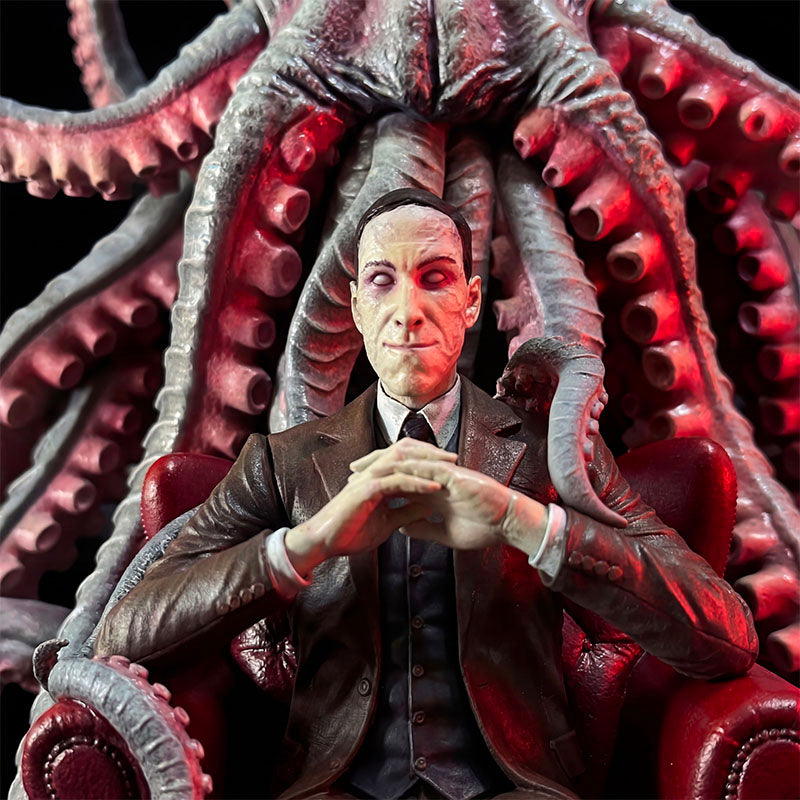
Art and Collectibles: The Mythos has generated an enormous ecosystem of artistic interpretation. Yet — until now — no studio had produced a statue that honored Lovecraft himself: the man, the writer, the mind behind the mythology. Not a creature. Not a tentacle. The author.
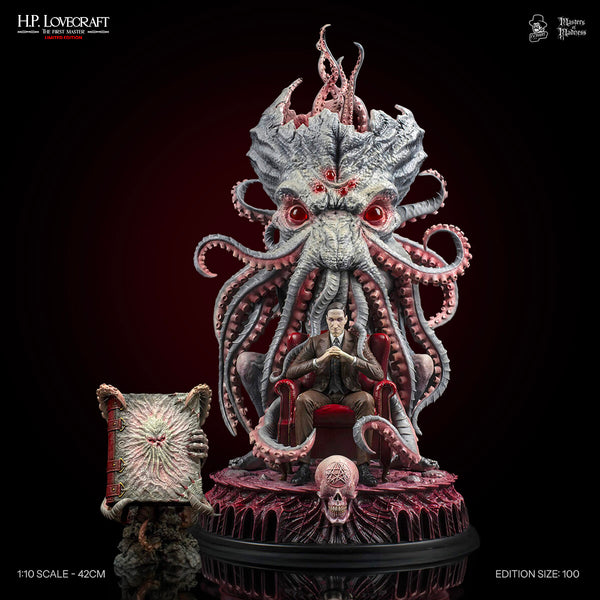
The Studio Everart H.P. Lovecraft Statue — Masters of Madness · Chapter I
This is what we built.
A 42 cm hand-painted polystone statue. 100 pieces worldwide — produced in two runs of 50. Each piece numbered, each carrying a certificate of authenticity. Once sold out, it will never be reproduced.
The design begins not with Cthulhu, not with the Necronomicon — but with a question: what moment defined Lovecraft's place in literary history? The answer is not a creature. It is a man alone with his paranoia, his vision, and his writing — building a mythology that the world would discover only after his death.
The statue includes:
- Two interchangeable portrait heads — Madness and Consciousness: two expressions of the man and his mythology
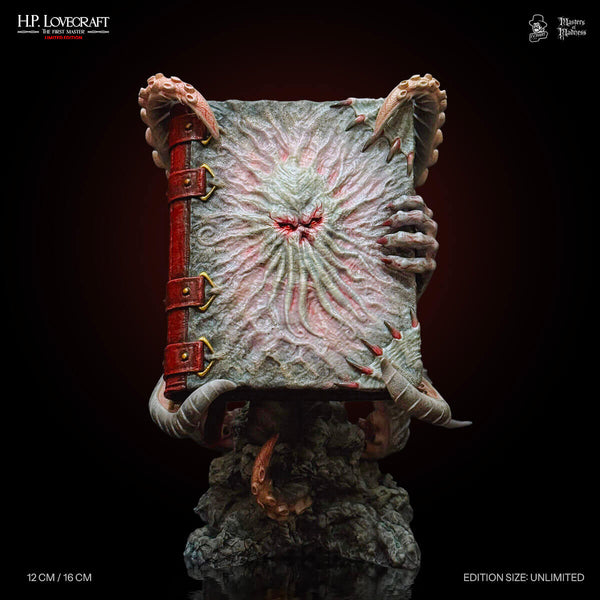
- A 12 cm Necronomicon replica in resin — a standalone collectible valued at €90
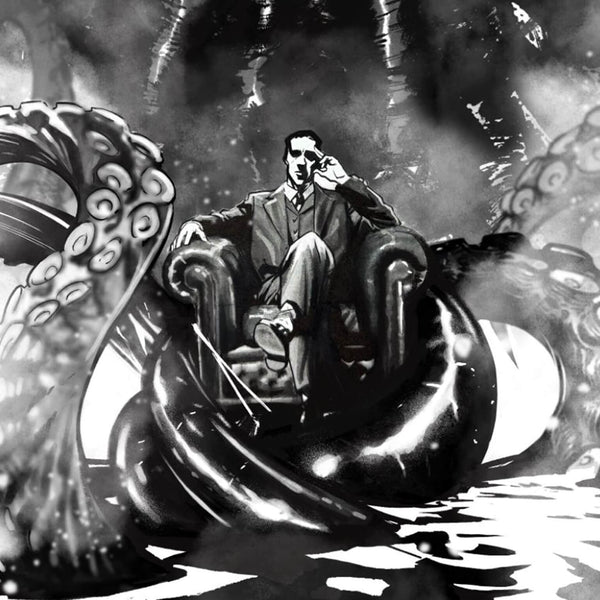
- An original 30×40 cm art print by Francesco Manna — B&W, exhibition quality, valued at €40
- A numbered certificate of authenticity — your number is yours. Forever.
Sculpted by Giacinto Platania and Simona Bordonaro. Over 200 hours from concept to final piece. Polystone. Hand-painted. 1/10 scale. Inspected before shipping.
Shipping: June 2026. Estimated delivery: August–September 2026.