Howard Phillips Lovecraft died poor and nearly unknown in 1937. Today his ideas run through film, games, and fine art. The distance between those two facts is the most useful thing a collector can understand. Permanence was not given to Lovecraft. It was rescued.
Providence beginnings
Lovecraft was born in Providence, Rhode Island, in 1890, and the city shaped him. He read early, wrote constantly, and rarely left New England for long. Providence stayed his anchor through illness, poverty, and a brief marriage. He called himself an antiquarian, a man more at home in the past than his own decade.
The pulp years
His stories ran in Weird Tales and other pulp magazines through the 1920s and 1930s. Pay was thin and late. He revised other writers' work for money. He built his mythology in letters as much as in fiction, exchanging thousands of pages with a circle of younger correspondents who would later carry his name.
Death in obscurity
Lovecraft died in 1937 of intestinal cancer, at forty-six, with almost no books in print under his own name. Many of his papers went to the John Hay Library at Brown University within months. He expected to be forgotten. He nearly was.
The rescue
Two younger writers, August Derleth and Donald Wandrei, founded Arkham House in 1939 to keep his fiction in print. They collected the scattered stories into hardcover. That single act preserved the work long enough for the rest of the century to find it. Everything after, the films and the statues, stands on that decision.
Why permanence matters to collectors
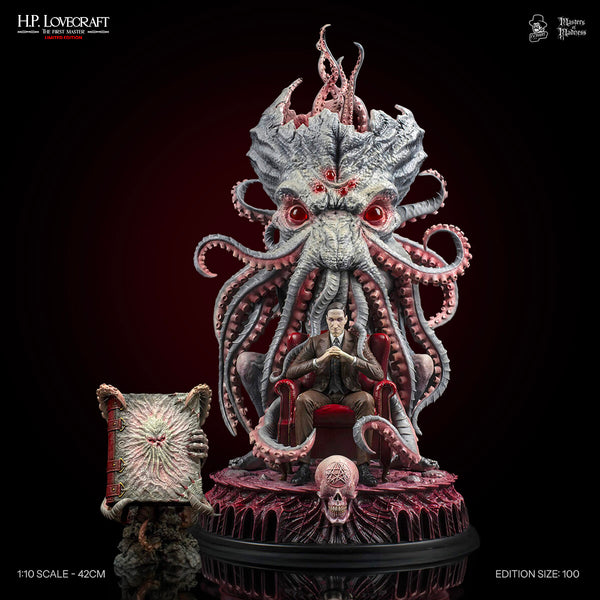
A Lovecraft piece is an investment in something that already survived erasure. Our Forbidden Edition statue treats the author as the subject, hand-painted and numbered, the first chapter of Masters of Madness. More on the man at the H.P. Lovecraft hub.
Lovecraftian glossary
- Weird Tales
- Pulp magazine that published most of Lovecraft's fiction.
- Arkham House
- Publisher founded in 1939 to preserve his work.
- Pulp
- Cheap fiction magazines printed on rough wood-pulp paper.
- Antiquarian
- A person devoted to the past and old things.
- Weird fiction
- Horror blending the supernatural with cosmic dread.
Sources

100 numbered pieces. Hand-painted. An original Studio Everart design.
£603.00 £654.00 View H.P. Lovecraft: The Forbidden Edition