There is a specific type of horror collector who came to Lovecraft not through a university course or a bestselling novel, but through a flickering CRT monitor at midnight. Before "cosmic horror" became a recognized genre tag on streaming platforms, a handful of game developers were translating the specific dread of the Cthulhu Mythos into interactive experiences — often with limited budgets, primitive technology, and a total refusal to compromise on atmosphere.
These are the games that built the aesthetic. Before Bloodborne. Before the mainstream discovered the Great Old Ones.
Alone in the Dark (1992) — The First House of Cosmic Dread
Infogrames' Alone in the Dark is frequently cited as the progenitor of survival horror, but its Lovecraftian credentials are equally important. The game takes place in Derceto, a Louisiana mansion whose previous owner, Jeremy Hartwood, killed himself to escape something living below. The enemies are lifted almost directly from the Mythos — Ghouls, Zombies animated by eldritch will, and a final adversary that belongs unmistakably to the tradition of the Great Old Ones.
The fixed camera angles, the cramped inventory, the sense that information itself was dangerous — Alone in the Dark understood that the most frightening thing is not what you see but what you almost see.
Call of Cthulhu: Dark Corners of the Earth (2005) — The Gold Standard
No game before or since has captured the literary texture of Lovecraft's prose with more fidelity than Dark Corners of the Earth. Developed by Headfirst Productions and published by Bethesda, the game adapts The Shadow Over Innsmouth with an almost documentary commitment to the source material.
The opening hours — set in Arkham's most disturbing hotel — are a masterclass in slow-burn dread. The Sanity system directly mirrors Call of Cthulhu RPG mechanics: witness too much, and your character's vision deteriorates, their breathing becomes ragged, they begin to hallucinate. There is no combat for the first third of the game. Only investigation, and the growing certainty that something is catastrophically wrong with Innsmouth.
For the serious horror fan collector, Dark Corners of the Earth remains the benchmark against which all other Lovecraftian games are measured.
Eternal Darkness: Sanity's Requiem (2002) — Nintendo's Forbidden Experiment
That a Lovecraftian horror game of this ambition was published by Nintendo for the GameCube remains one of gaming history's more surreal facts. Eternal Darkness, developed by Silicon Knights, follows twelve protagonists across 2,000 years of history, all drawn into contact with three Ancient beings of incomprehensible power.
Its most celebrated mechanic — the Sanity Effects — broke the fourth wall in ways that were genuinely unsettling for 2002 audiences. The game would pretend to delete your save file. It would simulate the television's volume dropping to zero. It would render your characters as translucent ghosts, visible only to entities they could not yet see.
Eternal Darkness understood something fundamental about Lovecraftian horror: the most effective dread is the dread that makes you question your own perception of reality.
Shadow Man (1999) — The Voodoo Apocalypse
Acclaim's Shadow Man is one of the most underappreciated dark fantasy games ever made. Drawing on Voodoo mythology, H.P. Lovecraft, and pure late-nineties industrial gloom, it follows Michael LeRoi — the Shadow Man — through Deadside, a decaying mirror-dimension populated by serial killers awaiting resurrection as heralds of the apocalypse.
The game's visual language is unmistakably Lovecraftian: architecture that should not be structurally possible, entities that exist in multiple states simultaneously, an ancient evil that predates human civilization and regards it with contempt.
Quake (1996) — id Software Stares Into the Abyss
John Carmack has acknowledged the Lovecraftian influence on Quake explicitly. The original game is not the frenetic military shooter its sequels became — it is something stranger and colder. The enemies are Shamblers, Fiends, Vores, and Spawn: creatures with no coherent taxonomy, drawn from no single mythology, unified only by their fundamental wrongness.
The final boss, Shub-Niggurath, shares its name directly with one of Lovecraft's Outer Gods. You do not defeat it in conventional combat. You lure it into a Slipgate — a dimensional portal — and obliterate it with its own teleportation technology. The game refuses to let you feel triumphant.
The Legacy These Games Built
These titles — developed before cosmic horror had a marketing category, before algorithm-driven content recommendation, before any of it — built an audience of collectors, readers, and artists who understood what Lovecraft was actually about. Not tentacles as decoration. Not eldritch as an adjective for aesthetics. But the genuine, earned dread of confronting a universe that has no obligation to make sense to you.
That audience grew up. They built collections. They sought objects worthy of the aesthetic they had been living inside since childhood.
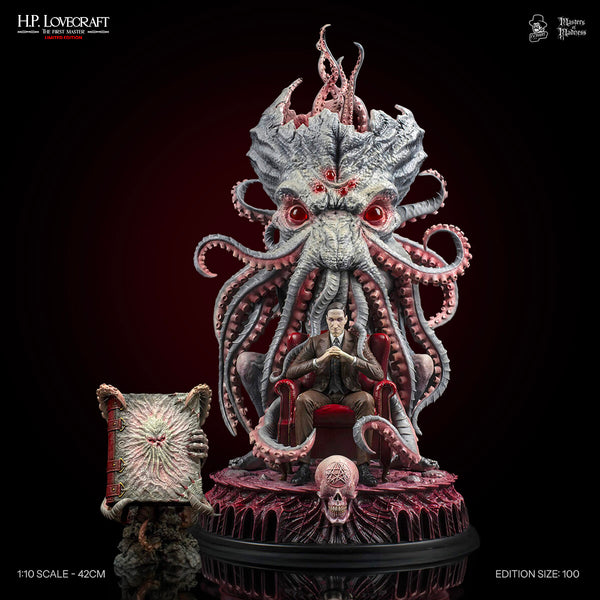
Studio Everart exists because of that audience. Our premium polystone horror figures — from the Cthulhu statue to the figures of the Forbidden Edition — are made for the collector who played these games, who read the original texts, who has been waiting for physical artifacts that match the weight of the source material.
The classic games laid the foundation. The collection is where it lives permanently.

100 numbered pieces. Hand-painted. An original Studio Everart design.
£598.00 £650.00 View H.P. Lovecraft: The Forbidden Edition