A Dark Cabinet: The Long History of Horror Collecting and the Objects That Define It
The impulse to collect the frightening is not modern. It is not even recent. It is one of the oldest documented human behaviors, and understanding its history helps explain why the contemporary horror collectible market — worth billions of dollars globally and growing — is not a fad but the continuation of something that has been running for centuries.
The objects have changed. The impulse has not.
The Wunderkammer and Its Dark Inventory
The Wunderkammer — the cabinet of curiosities — emerged in sixteenth-century Europe as the preferred format for displaying wealth, learning, and range of experience. These were not collections in the modern sense: they were theatrical installations, three-dimensional arguments about the scope of the collector's knowledge and the reach of their resources. A serious Wunderkammer might contain a nautilus shell, a piece of coral, a taxidermied bird of paradise, a mechanical clock, a set of prints depicting monsters from the new world, a mummified hand.
That last category is worth dwelling on. The most prestigious Wunderkammern consistently included objects of horror: anatomical preparations, death's-head imagery, memento mori of various kinds, objects that derived their value precisely from their relationship with mortality and the uncanny. Rudolf II, Holy Roman Emperor, maintained one of the most celebrated collections of the sixteenth century, and its inventory included materials that would be recognizable to any contemporary horror collector: disturbing anatomical curiosities, objects associated with occult practice, images of transformation and dissolution.
The message these collections sent was not simply "look at my wealth." It was more subtle and more interesting: I have looked at the frightening things and I have not looked away. I have brought them home and I keep them here. The dark is not, for me, somewhere else.
This is the same message that every serious horror collection sends today. The aesthetic vocabulary has changed almost completely. The underlying argument is identical.
The Victorian Obsession with Beautiful Death
The nineteenth century intensified the relationship between collecting and horror in ways that were culturally specific but also, in retrospect, almost inevitable. The Victorian era was defined by a paradox: it was a period of radical faith in rationalism, scientific progress, and the progressive improvement of the human condition, and it was simultaneously one of the most death-saturated cultures in Western history.
Victorians did not merely encounter death. They cultivated a rich material culture around it. Mourning jewelry — pieces that incorporated the hair of deceased loved ones, sometimes woven into elaborate patterns, sometimes pressed beneath crystal — became a significant commercial and artistic category. Photographs of the dead, arranged to simulate life, were made and preserved as family documents. The memento mori tradition, ancient in its origins, found renewed expression in the Victorian drawing room.
The horror fiction of the period — Poe, Sheridan Le Fanu, Bram Stoker, eventually Machen and Blackwood — both reflected and fed this preoccupation. Gothic literature provided a narrative framework for the material culture of death, and the objects associated with Gothic fiction began to acquire value as artifacts.
The first dedicated horror collectibles in the modern sense emerged from the theatrical tradition of this era. Stage productions of Dracula and Frankenstein generated posters, programs, and prop reproductions that audiences sought out as mementos. The object's value was its relationship with fear — specifically, the fear the production had induced, made portable and displayable.
The Golden Age of Monster Cinema
The twentieth century transformed horror collecting through cinema. When the great Universal monster films of the 1930s and 1940s entered the culture, they created a new category of desirable object: the screen-used prop, the production still, the lobby card, the poster that had actually hung in a theater where audiences had been genuinely frightened.
These objects derived their value from a logic that remains central to high-end horror collecting today: proximity to authentic experience. A poster from a theater where Karloff's Frankenstein creature had terrified an audience in 1931 carried something of that terror into subsequent decades. Ownership was a form of inheritance — you were acquiring not just an image but a documented relationship with the history of fear.
The magazine culture that grew up around genre cinema — publications dedicated to horror and science fiction film that began appearing in the 1950s — accelerated the collectible economy enormously. These magazines published images, behind-the-scenes content, and equipment details that transformed monsters from screen presences into physical entities with documented makers and materials. The creature was now also an artifact, and artifacts could be collected.
By the 1960s and 1970s, model kit culture had democratized horror collecting in ways that had lasting consequences. Snap-together plastic kits of the classic monster designs — available at modest prices through mass-market retailers — introduced an entire generation to the satisfaction of assembling and displaying horror iconography in three dimensions. Many of the most serious contemporary collectors trace their engagement with the form to these early kits, which were also, for many of them, their first experience of making something frightening beautiful.
The Contemporary Market: Where Craft Meets Rarity
The horror collectible market of the early twenty-first century is defined by a tension between scale and scarcity. The industry's commercial center of gravity involves large-run products, widely distributed, priced for accessibility. These are legitimate and valuable objects for certain collectors and certain purposes.
But the most significant movement in contemporary serious horror collecting runs in the opposite direction: toward smaller editions, higher craft ambitions, original concepts, and the kind of object that does not simplify the material it addresses.
The most sought-after contemporary pieces share certain characteristics that distinguish them from mass-market production:
Sculptural originality. The best contemporary horror sculpture is not reproduction — it is interpretation, or original concept. The sculptor brings a perspective, a specific artistic intelligence, to the material rather than simply executing a licensed design to specification.
Material integrity. Premium polystone, hand-painted by a single artist, has become the standard for the highest tier of the market. The material allows for micro-detail that mass production cannot achieve; the hand-painting means that finish variations between pieces are evidence of authenticity rather than quality failures.
Narrative depth. The most requested contemporary horror pieces are those that tell a story the viewer has to spend time with — that reward return attention, that reveal new details and implications upon subsequent viewing. This is, in part, a reaction against the majority of the market, where the aesthetic impact is immediate and exhausted quickly.
Genuine rarity. Limited editions of one hundred pieces or fewer are now understood as a meaningful threshold. Above that number, the piece begins to feel abundant; below it, each numbered artifact carries weight that open editions cannot replicate.
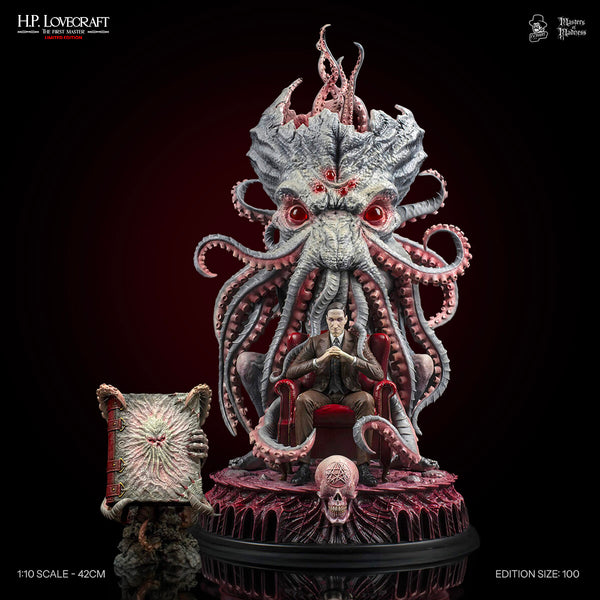
Studio Everart's work sits at the intersection of all four of these qualities. The H.P. Lovecraft statue, the Necronomicon replica, the pieces that constitute the Masters of Madness collection: these are objects built for the collector who arrived at this point through a long engagement with the literature, the films, the mythology. They are made by people who share that engagement, who understand that the collector's relationship with cosmic horror is not decorative but intellectual and emotional in ways that deserve to be taken seriously.
The Collector's Argument
A collection is, among other things, an argument. It argues that the objects it contains are worth preserving, worth displaying, worth the sustained attention that serious collection implies. A horror collection makes a more specific argument: that the dark material — the frightening stories, the monstrous images, the objects that live at the edge of what is comfortable — is worth inhabiting, worth keeping close, worth returning to.
This is not a simple argument to make. It requires a relationship with darkness that most people are not prepared to sustain. Horror collecting has always been a minority practice, even within the broader world of collecting, because most people prefer to keep the frightening at a distance rather than install it on a shelf where it can be contemplated at leisure.
The collectors who do this — who have done it, in various forms, for centuries — share a quality that the history of the practice makes visible: they are not frightened of the frightening in the way that most people are. They have looked at it long enough to understand that the fear it generates is a specific kind of value, a signal that something real and important about human experience is being addressed. And they would rather live beside that signal, in all its discomfort, than live without it.
This is why horror collecting is not a trend. It is a tradition with deep roots and serious practitioners. And it will continue as long as there are people who understand what it means — and studios willing to make objects equal to that understanding.
Studio Everart creates strictly limited horror collectibles for the serious collector.

100 numbered pieces. Hand-painted. An original Studio Everart design.
£599.00 £650.00 View H.P. Lovecraft: The Forbidden Edition